
Smart Office

Telstra Claims QR Codes Will Change Advertising Industry

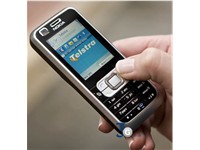
Telstra customers will soon have software downloaded free to their mobile phones, through QR coding technology, giving them quick access to websites and mobile content via special barcodes.


Click to enlarge

Telstra Group Managing Director for Consumer and Channels, David Moffatt says that, “this is the first time in the world that barcode readers have been automatically installed on mobile phones for free”.

Moreover, Telstra also says the technology has the “potential to radically change the print and outdoor advertising industry by providing advertisers the opportunity to have more meaningful dialogue with customers and a better understanding of their interests”.

According to the telco, customers simply point their mobile phone cameras at the specially designed barcodes, known as Telstra Mobile Codes, to access content such as weather, localised maps and mobile videos. The barcodes can be placed on virtually any surface including newspapers, clothes, business cards, shop fronts, product packaging, billboards, bus stops, magazines, menus, TVs and computer screens.


Moffatt, said ” The barcodes are two dimensional squares with unique pixel configurations which, with a single point and scan with a compatible Telstra Next G mobile phone, can take users to online destinations including mobile websites with to-the-minute information, video content and special offers”.

Telstra spokesman Peter Taylor notes that this technology is big in Japan and really is designed to be “a call to arms for the advertising industry”.

“This technology has a number of very clear measurables”, making it perfect for advertisers he said.

Taylor however, would not be drawn on how much this could potential turnover for the advertising industry.

The sorts of content to be available through the QR Codes include the latest news, sport and weather information; music files; maps; store information; tickets to shows; video presentations that give users guided tours, how-to information and trailers; links to social networking sites and special discount offers.

Google Releases First Patch For Chrome

Google has issued an update for its new Chrome browser, following a critical security flaw found by Vietnamese security researchers.


Click to enlarge

According to a report in techworld.com, a researcher at the Hanoi University of Technology, the Chrome beta browser posted last week contained a buffer overflow bug that could be used by attackers to hijack PCs.

The researcher found that the flaw can be triggered when the user saves a web page – using Chrome’s “Save page as” command – with a very long name, which created a stack-based buffer overflow that hackers can leverage to introduce additional malicious code.

“To exploit the vulnerability, a hacker might construct a specially-crafted web page, which contains malicious code”. “The hacker would then trick users into visiting his site and convince them to save this page”, thereby giving access to the PC, according to the report.

Google said it has patched the vulnerability Sunday and released an updated beta, version 0.2.149.29, on the same day.

Customer 2.0–Social Networking Sites The New Business Tool

According to a recent survey by Gartner and other analysts, the majority of users of social networking sites are motivated mainly by “personal needs and a desire for entertainment, rather than business and practical objectives”. However some have seen the potential of such sites for business.


Click to enlarge

“Social networking software holds enormous potential for improving the management of large enterprises,” said Nick Ingelbrecht, research director at Gartner. “However, work in this area is still immature, and in the meantime, enterprises should be aware of what is happening in the world of consumer social networking and implement appropriate usage policies for employees’ use of services such as Facebook and MySpace on company time.”

Gartner predicts that online social networking will come to be regarded as just the latest expression of a long-standing pattern of human behaviors that involves an increasing range of communications protocols and technologies.

In the US, some companies have been quick to realize the potential to drive sales on sites such as MySpace and Facebook.

According to analysts, The Aberdeen Group, companies are successfully using social media to improve customer satisfaction and retention, and derive actionable marketing insights.

The Aberdeen Group found that “These online communities let customers, prospects, employees and partners connect with each other and share content. At the core of the Awareness solution is an on-demand social media platform that combines the full range of Web 2.0 technologies — blogs, wikis, discussion groups, social networking, podcasts, RSS, tagging, photos, videos, mapping, etc. — with security, control, and content moderation”.


Some larger companies are also using social sites to make fast business decision. Hewlett-Packard, executives for example, log into their individual blogs each morning to join the ongoing online conversation about each of their product lines, immediately responding to customer problems and concerns.

Ernst & Young recruits many of the 3,500 college graduates it hires every year using a career group on Facebook, where it not only posts job information but also answers individual questions from prospective employees.

And according to Reuters, small-business social networking in the US is expected to increase between 20 to 33 per cent this year.


.Org Domain Passes The 7 Million Mark

The Public Interest Registry, the registry behind the global .Org domain name, says that more than 7 million domain names are now registered as .Org, making it the third largest generic domain (after .com and .net).


Click to enlarge
courtesy:www.arnotts.net.au

Since management of the registry was taken over by the Public Interest Registry in 2003, .ORG registrations have increased more than 250 per cent.

 “This is a significant milestone for .Org, as it has consistently grown 20 per cent percent year over year since its management by Public Interest Registry,” says Alexa Raad, CEO. “.Org continues to be the domain of choice for individuals and organisations who seek to brand their efforts under a globally trusted and respected address.”

 The growth in .Org registrations has been driven by internet and societal trends such as social networking, issue awareness, online collaboration and advocacy, all of which have accelerated since 2003. Some notable examples include:
 
— the increasing number of for-profit organizations who choose .Org addresses to emphasize their service missions and as Craigslist puts it, their “non-corporate culture”;
 
— the launch of community sites such as freecycle.org;
 
— increasing number of wikis for collaborative content, made popular by wikipedia.org;
 
— the growth in online political organizing;
 
— empowered bloggers who start their own websites to further their passions or causes such as takebackthefilter.org; and
 
— the growth of the “green” movement as shown by sites like sustainablog.org.
 
“We can’t imagine Wikipedia as a .com — .Org is a core part of our identity,” says Jimmy Wales, Founder of Wikipedia and member of the Board of Trustees of The Wikimedia Foundation. “.Org is available to anyone in the world, and it is a great way for an organisation to signal an ambition to be inclusive and global.”
 

Malware Invoices & Viral Packages Flooding SMB Inboxes

Many small businesses wrongly believe that they’re too insignificant to attract hackers and spend too little time on security but according to Secure Computing, since the beginning of July there are steady waves of mass-mailings hitting inboxes with fake invoices.


Click to enlarge

This includes fake UPS messages claiming that a package couldn’t be delivered and was returned, the user should print out the attached invoice – which in fact is the actual piece malware.

Just yesterday two different spoofs were on the loose, containing both the very same malware.

One in German language claiming to be an invoice from PayPal Europe and the other pretending to be from the US Custom Services.

And just today says Secure Computing, the next spam run brings in an invoice for a flight ticket. Victims are told they’ve bought an airplane ticket and their credit card was charged. The details and the flight ticket are attached – again this is malware.

Secure Computing says that users who fall prey to these common social-engineering tricks and install one of these nasties on their computer, actually install a ZBot spyware (aka ‘Wsnpoem’, aka ‘ntos.exe’). ZBot, depending on the actual variant, downloads an encrypted configuration file with further instructions from a Russian location and posts collected data back.

Hundreds Of Sites Exploiting Unpatched IE Bug

Web filtering security company Websense says its ongoing scan of the Intenet has turned up hundreds of sites exploiting an unpatched security whole in Microsoft’s Internet Explorer.

Using honey clients, Websense constantly scans the internet at the rate of 75 million per day looking for malicious websites. As new websites are discovered and researched, they are added to the Websense URL database and categorised. Websense defences work by adding malicious websites to a black list database using real time updates.

The websites are specially crafted to exploit the IE vulnerability which allows them to run code on the user’s machine. The vulnerability allows a malicious attacker to run shell code that connects via HTTP and downloads malicious code such as Bot variants, backdoors, and other Trojan Horses.

This latest “zero-day” vulnerability in IE is unlikely to be patched until next month at the earliest leaving surfers with no protection against the existing sites exploiting the vulnerability.

“This exploit demonstrates the power of the Websense security solution. Even before the vulnerability can be patched and anti-virus signatures were available, Websense security customers were protected,” said Leo Cole, vice president, marketing for Websense, Inc. “This level of detection and automatic protection is only available with Websense’s web security approach.”


Yahoo!7 To Get A Major Nip And Tuck

In terms of portal reassignment surgery, locally, it doesn’t get much bigger than this as Yahoo7 is set to announce the redesign of its online portal and also launch its biggest marketing campaign since the start of the joint venture between Yahoo and Channel Seven in 2005.


Click to enlarge

And reports abound that there will be a greater emphasis on content aggregation, more diversified news feeds as well as the potential for a new delivery platform, although Yahoo7 has to confirm or deny this.

And it seems, from a graphic standpoint, there will be cosmetic changes as well as the original purple will return as the signature brand colour of Yahoo7 and the Yahoo model will also be brought back as the brand’s signature.

The launch tomorrow night is being taken as a straight-out pitch to the advertising industry to show the portal some serious love, with a guest list that is understood to include the heads of many of Australia’s top and most influential advertising agencies.

According to reports, someone at Yahoo7 has rediscovered the meaning of convergence, as there will also be more access to Seven’s stable of magazines at Pacific Magazines and the new site will also allow localised content relating directly to the user’s suburb to be delivered.

Yahoo7’s relaunch is seen as a way to take leverage the increasing user personalisation of web sites and also to reinvigorate the online appeal to advertisers as growth in online spend is reported to have slowed somewhat this year.

Pic: (c) goosmurf


iPod Owners Beware–Customs Wants To Have A Peek Inside

According to the UK Guardian newspaper, moves are afoot to enable governments around the world to have the power to have a peep into your iPods.


Click to enlarge

According to the article, as the heads of the G8 governments meet this week, they are also about to ratify the Anti-Counterfeiting Trade Agreement (Acta), which “could let customs agents search your laptop or music player for illegally obtained content”.

The article also notes that “the European Parliament is considering a law that would lead to people who illicitly download copyrighted music or video content being thrown off the internet” and Virgin Media is now writing to hundreds of its customers at the request of the UK record industry to “warn them that their connections seem to have been used for illegal downloading.

Viacom gets access to all of the usernames and IP addresses of anyone who has ever used YouTube as part of its billion-dollar lawsuit in which it claims the site has been party to “massive intentional copyright infringement”.

According to the report, a draft copy of the EU legislation contains the paragraph: “Members shall provide for the provisions related to criminal enforcement and border measures to be applied at least in cases of trademark counterfeiting and copyright piracy.” -which can clearly be interpreted as meaning that you could be stopped at Customs and quizzed about the contents on your iPod or laptop.

And as for ISPs, the next step could be that they could dob in downloaders with the backing of the law.

And the implications for privacy?, asks the Guardian — well unsurprising, as the signatories would include the “US, UK and China -which have widely diverging ideas on the topic”.

Internet freedom, it seems, is all in the eyes of the observer.

Sleek Wireless Gateway From Linksys

Linksys has released the WAG160N Wireless-N ADSL2+ Gateway.


Click to enlarge

Like the broadband version, WRT160N and the gigabit version, WRT310N, the WAG160N features the new sleek design with internal antennas and the Linksys Easy Link Advisor (LELA) software.  

The Linksys by Cisco WAG160N is available now through authorised distributors, quality retailers and resellers for a recommended retail price of AUD$199.95.