

Boasting a four fold increase in performance on its notebook PCs Apple will put an Intel inside from next month.
 Staff Writers
Aussie Company To Make Flash Cards
Australian listed memory and consumer electronics vendor Legend has announced its entry into a new market – memory for mobile phones.
In an Australian first, the MMC flash media cards will be manufactured locally at Legend’s Adelaide production facility as well as at the company’s
The company is planning a range of Multi Media Card (MMC) flash media products which are suitable for most new mobile phones.
Legend’s CEO Mr Bradley Dowe described the decision as a prudent next step for the company. “Legend is excited to be addressing this rapidly growing market and we see a great opportunity to lever new business within the telecommunications sector,” says Dowe.
“As consumers demand more functionality from their mobile devices they naturally require additional storage to support their applications. As a digital technology company we are pleased to be able to respond quickly to consumer demand and provide a quality product to meet this rapidly expanding market segment,” he said.
The Legend manufactured flash card will initially be marketed in capacities ranging from 256MB to 1GB and will be offered for sale to existing OEM customers, distributors and retail department store clients. The Legend MMC card will also pave Legend’s entry into a new mobile telephone market segment and provide sales opportunities for other Legend products targeted towards leading handset manufacturers, telecommunication service providers and specialist telephone retailers.
Home Networked Storage–How Far Can It Go?

According to ABI Research, more than 50 per cent of US high-speed Internet subscribers have set up some kind of home broadband network- a figure that could be equally applied here in Australia.
 Click to enlarge |
| courtesy:www.gizmodo.com |
Home networking has shifted from being an early adopter technology, to one that is now integral and a key driver to home entertainment as it is increasingly being used to connect PCs, laptops, game consoles, PVR’s and a plethora of other mobile devices over a single household broadband connection.
According to Mike Wolf, director at ABI Research, “Our research shows that more than a quarter of home network owners have a games console on their home network, while another eight per cent have connected their mobile phone
So as the market for home networks grows increasingly matures, hardware vendors are looking for new areas of revenue growth, beyond gateway and home router products.
Analysts Parks and Associates note that home networked storage in the US which has gone from 0.3 per cent of multiple-PC households in 2004, will by 2010, hit almost 10 per cent – a 33-fold increase.
And these new areas of focus include media adapters and network attached storage, which are showing initial signs of progress.
But the key to success, according to ABI, will be to create plug-and-play next-generation products that can be seamlessly integrated with existing home media networks.
And just looking at the hard drive sector, its not hard to see that some vendors have caught the prevailing wind and just keep offering more capacity at a lower price.
Seagate for example has just introduced the industry’s first 1.5-Tbyte PC hard drive and 500-Gbyte notebook PC drives, while Hitachi Global Storage Technologies unveiled the latest generation of its 1-Tbyte server drives.
The Seagate Barracuda 7200.11, which at 1.5 Tbytes of raw capacity is the largest hard drive in terms of capacity in the market, also made the largest jump in IT history from one size to another, with an instant 500 Gb jump from the previous model Seagate HD, which was 1 Tb.
With this big HD, Seagate is squarely targeting high-end and gaming PCs, workstations, desktop RAID appliances and also mainstream users who are just starting to do more with such new technologies as video making.
The Barracuda 7200.11 hard drive packs 1.5 Tbytes on four platters, and includes a 3-Gbit-per-second SATA interface for a sustained data rate of up to 120 Mbytes per second and is expected to ship in September in Australia and cost around $US500 – only 8 years ago, such a HD would have cost many thousands of dollars and taken up an entire rack in a server room- today 1 Tb is about the size of a house brick – as the price has fallen, so has the physical size of the drives.
Seagate, for its part says there has been an overall 80 per cent year-on-year increase in home/office HD usage from 2001 to the end of this year – in fact notes the company, since 2004, it has been the home market leading sales in storage over the professional sector and the gap increase between home and business is increasing all the time – in the favour of home.
Looking at the market through the eyes of the notebook HD sector shows this up as clear as day – the average price of a notebook hard drive at the end of 2007 was US$50 compared to US$85 in 2006, and this year, that price is set to fall to sub-US$40, according to some storage vendors such as Quantum.
Standard storage space for notebooks however over the same period went from an average of 40-80 Gb to now 160-250 Gb as a standard offering in most portable devices.
And over at enterprise storage vendor EMC, there are moves afoot to go head first into the consumer storage space, as the company wraps up its $US213 million acquisition of Iomega corporation, a well-known brand in the home/office market.
This purchase marks EMC’s first move into consumer hardware, one that will surely push other vendors to come up with newer, bigger and cheaper offerings in the not-so-distant future.
Just like gaming, it seems the explosion in home entertainment and all the new and extra media involved will mean that not only will home storage devices continue to fall in price, but at the same time, their storage capacity will grow at an ever-increasing rate.
OLED TV & Mini Notebook Panels Set For Sales Surge
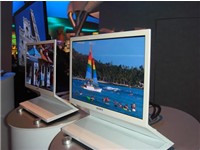
According to DisplaySearch, there will be a 167 per cent compound annual growth rate (CAGR) for shipments of OLED panels from 2007 to 2015, and a CAGR for mini-note PC applications of 74 per cent over the next eight years.
 Click to enlarge |
“OLED TV and mini-note PC applications are the next big opportunity for flat panel suppliers,” explained David Barnes, VP of Strategic Analysis for DisplaySearch. He added, “Last year, we identified the potential for digital picture frame demand to lead unit growth. That application is still growing strong but these two applications will be even stronger.”
Shipments of flat panels for all applications decreased 12 per cent from Q4’07 to 881.7 million units on normal seasonal weakness in Q1’08.
Compared to Q1’07, shipments increased 15 per cent, led by demand for mini-note PC, digital picture frames and portable navigation devices.
On a unit share basis, mobile phone applications consumed 45.8 per cent of all flat panels in Q1’08.
By comparison, the next largest consumption came from conventional PC applications for desktop and laptop displays, which used 9.1 per cent of the flat panels shipped.
Panels for LCD TV and Plasma TV sets comprised 3.5 per cent of shipments.
On a display area basis, TFT LCD technology provided 88.6 per cent in Q1’08.
PDP technology delivered 9.4 per cent and OLED delivered 0.1 per cent of the total.
Xbox To Get HD-DVD
Launching ahead of the Sony PlayStation 3, Microsoft’s xBox may have gained first mover advantage, but it did so at a cost.
While the Sony console will sport a next generation, high definition DVD drive, Microsoft, which is really yet to fully endorse either Blu Ray or HD DVD, opted for a standard DVD drive in its second generation console.
However, the word from
According to industry sources cited in this story, Microsoft is looking to place OEM orders with optical disc drive manufacturers for an external HD-DVD player to go with the xBox.
However, the company declined to confirm the rumours as did leading manufacturers BenQ, Lite-On and Quanta.
The move could stem defections to Sony’s PS3 which will feature the company’s Blu Ray high def drives which will offer the larger storage capacities required to cater for high level graphics capabilities.
Epson Gilds Synnex Consumables
Epson, which has been battling to remove non-genuine printer cartridges from the local market, has appointed Synnex as a Gold Seal distributor.
Synnex has been distributing Epson consumables sing October 2004, but the hardware relationship goes back to a year earlier than that.Now the two have stepped up their commitment in a relationship that helps Epson ensure genuine consumables are getting to the market.Synnex says it plans to “heavily push the Epson Gold Seal program to encourage resellers to purchase through authorised channels”.Managing Director Frank Sheu said, “We are pleased to have gained gold status. Part of the whole Gold Seal status program is to ensure that the channel gets genuine product and we are more than capable of providing this”.
Adding Synnex to the partner program ensures the distirbutor is selling legit product explained Epson National Sales Manager Toni Pensa.”Gold Seal is a guarantee to resellers that they will be purchasing genuine consumables. This is a strategic move as Synnex is a prime consumables distributor. By adding Synnex to the program we are assuring resellers that any Epson consumables they buy from Synnex are genuine,” he said.Sheu said Synnex will target resellers who are presently selling unauthorised products or third-party compatibles.Victorian police recently charged an eBay sales outfit selling what it claims were counterfeit cartridges worth up to $130,000.
Easybiz Search Engine Platform For SMBs

Easybiz, a Search Engine Optimisation (SEO)-based business directory has released its commercial platform that provides small businesses with a value-for-money means of building the type of SEO-enabled website.
 Click to enlarge |
Easybiz draws on high-end Web development expertise (including SEO and search-engine friendly design knowledge drawn from building some of Australia’s largest websites).
Easybiz advertisers who have an unique URL (as well as an Easybiz URL for their business) typically find that their Easybiz address ranks above their own URL in a Google search on their business name.
Easybiz’s powerful search algorithm provides a source of competitive advantage for businesses, as it allows their customers to find the business by searching on their name, or on products that the
Additionally, Easybiz also provides businesses with an easy-to-build or update website that includes, uniquely in the market, five pages of catalogue – making it an suitable for retailers who want to promote in-store ranges or store specials.
Easybiz typically costs less than $1,000 pa to deliver its benefits to growing businesses.
Myspider Weaves Job Aggregates Web

Myspider is a specialised job search engine which aggregates job content from approximately 100 job sites around Australia.
 Click to enlarge |
It offers a free service to jobseekers to search job vacancies across all industries, which are showcased in one convenient place online. When applying, the jobseeker is referred back to the originating website to complete the formalities.
The most popular industries for job search in the last quarter have been Mining (7.2 per cent), Information & Technology (5.7 per cent) and Hospitality & Tourism (5.7 per cent).
Unlike commercial job boards, which are a repository of paid job ads from employers and recruiters, Myspider simply aggregates these and makes them available through its search engine.
To provide even greater convenience, jobseekers may subscribe to daily job alerts which email new jobs matching their individual preferences.
Myspider offers businesses the opportunity to promote their products and services to a growing consumer audience online. Advertising on the search engine may be targeted to industry, specific location, keywords or customised marketing campaigns through e-newsletters and daily job alerts.
See www.myspider.com.au
Volante Shares Recover on Assurance
Shares in budding systems integration company Volante recovered around four percent today after falling consistently for the past month.
In early November trading, Volante shares took a nose dive moving from a relatively stable $1.38 to around $0.94 in a matter of days. The slide continued until the stock bottomed out yesterday at around $0.68 (losing investors more than half their money in less than a month).
The system integrator is in the middle of changing its business model and is trying to increase its revenue share form services away from low margin product sales. Ass part of this change, the company has had some restructuring costs, but according to today’s statement to the ASX, it sees no reason why it should be punished so harshly.
“Following Volante’s announcement on 11 November 2005, and noting the recent decrease in the price of the Company’s securities, the directors wish to advise that: they are not aware of any information or reasons that can be attributed to the recent decrease in the price of the Company’s securities; and trading results to the end of November 2005 have confirmed that the Company’s expected net profit after tax will be between $2.0 – $2.5 million for the first half, with EBITDA expected to be between $11.5 – $12.0 million, as per the Company’s announcement on 11 November 2005,” it said in a company statement.
In response, the company’s stock price recovered about four percent (as at
Linksys SMB Switch Range
Cisco division, Linksys, has a new line-up of Gigabit and Fast Ethernet switches for small businesses.
The eight new switches, part of Linksys WebView small business solutions switch family. The rackmount switches include remote browser management and traffic monitoring of its 48 10/100/1000 ports. Fibre expansion options are available via mini-GBIC ports.
“Starting at about US$9 a port, our new small business solution switches provide just what our resellers and business customers have been asking for: speed, affordability, configurability and ease of use,” said Richard Platt, vice president, Linksys small business systems business unit.
“We enhanced our gigabit switches with more features that optimise network performance while providing expandability options as network needs grow. Linksys is building out its small business line to offer a complete portfolio of solutions that will meet the needs of all types of small business demands.”
Automatic containment of Broadcast, Multicast and Unknown Unicast storms minimises the effects of such traffic on regular traffic.
The new WebView monitoring includes the following configuration options:
- Port Configuration for Speed, Duplex Mode
- Enable/Disable ports
- VLAN Configuration for up to 64, 128 or 256 VLAN’s
- Port Trunking
- QoS priority traffic settings
Pricing and Availability
All the WebView switches are immediately available through Ingram Micro, Multimedia Technology, Express Data and LAN Systems immediately except for the SRW2024P and SRW248P which are scheduled to ship later. The Estimated Street Pricing is as follows:
- 16-Port Gigabit Switch with WebView (SRW2016): $779.95
- 24-Port Gigabit Switch with WebView (SRW2024): $1009.95
- 48-Port Gigabit Switch with WebView (SRW2048): $1909.95
- 24-Port Gigabit Switch with WebView and PoE (SRW2024P): TBA
- 24-Port 10/100 + 2-Port Gigabit Switch with WebView and PoE (SRW224P): $999.95
- 48-Port 10/100 + 2-Port Gigabit Switch with WebView and PoE (SRW248P): TBA
- 24-Port 10/100 + 2-Port Gigabit Switch with WebView (SRW224): $499.95
- 24-Port 10/100 + 4-Port Gigabit Switch with WebView (SRW224G4): $539.95
- 48-Port 10/100 + 4-Port Gigabit Switch with WebView (SRW248G4): $999.95