Smart Office

Tough Times Ahead for PDA Market

IDC has predicted the smart handheld device market is set to face lean times.

Its recently released Q106 results for the Australian smart handheld device market reveal that pen-based and converged categories contributed to a fall in shipments. IDC’s report concluded that Pen-based shipments fell by 18.6% sequentially while the combined converged market fell by 1.5% compared to 4Q05. Converged devices accounted for 93.0% of all smart handheld device shipments during the quarter.

In addition, IDC has found the following key highlights of the 1Q 2006 smart handheld device market:

1) Entry-level market depletion: Overall pen-based shipments are expected to dwindle and continue its escalated descent, and there will continue to be limited demand from end users seeking basic devices with Personal Information Management (PIM) functionality at affordable prices. Currently, these low-end devices are performing well in low-cost retail channels. However, with converged mobile device functionality increasing and prices dropping, users interested in entry-level mobile devices will opt for a converged mobile device instead of a handheld device.

2) Search for new functionality continues: Pen-based or PDA device vendors have failed to breathe new life into their devices despite innovations such as integrated GPS and hard drives that aim to offer innovative usage models beyond the traditional PIM functionality. Despite the rising attach rates with new technology, net growth continues to be elusive to these vendors. In contrast, converged devices that also offers PIM capability lessens the pen-based device vendors’ ability to leverage PIM as a competitive advantage.

3) Price sensitivity: The expectation for lower pricing by end users has the potential to force device vendors into a downward spiral of lowered prices and thinner margins. Although this would appear to affect both handheld device and converged mobile device vendors equally, converged mobile device vendors will escape part of the pain by selling their devices at full price to a carrier that swallows the discount cost of the subsidy. Meanwhile, without another party to take the brunt of the discount, pen-based device vendors will face increasingly smaller margins and tougher sales if they want to stay price competitive with converged mobile device vendors.

Market Analyst, Mercie Clement, said “In terms of vendor rankings for the total smart handheld device market, Nokia continued to be the dominant player, accounting for 77.1% share of total shipments in the quarter. Both Research in Motion (RIM) and i-mate finished the quarter in second place, with 4.9% share. HP finished the quarter in the fourth spot, with 4.1% share of all handheld devices shipped during the quarter and rounding out the Top 5 was O2 with 3.9% share.”

Top five vendors (total smart handheld device market):

Nokia 77.1%
RIM  4.9%
i-mate 4.9%
HP  4.1%
O2  3.9%

iPad 2 Sweats As Samsung Galaxy 10.1 Tab Unleashed, Apple Slings Mud

Arch rivals Samsung and Apple prepare to battle it out for the hearts and minds of tab users as Cupertino upps legal battle with the Koreans.


Click to enlarge
Pictured: Samsung’s latest tab on the block, the 10.1 Galaxy Tab

Samsung’s Galaxy 10.1 Tab on Honeycomb 3.0 has just been unleashed to consumers in the US, emerging as a serious rival to the dominance of iPad 2.

The 10.1″ tab (not to be confused with the newly released 10.1v Tab on Froyo 2.2) promises to be “thinner and lighter” than previous Galaxys.

And at 595g and 8.6mm thick it is slimmer than its Apple rival and packs a tougher punch specs wise with larger screen, higher resolution (1280×800 V iPad 2’s 1024×768) and higher megapix on its dual cameras. Ouch.  

And at $499 for 16GB ($599 for 32GB) it is looking to match iPad 2 at the tills also, although notably didn’t look to undercut Apple’s pricing.
But, it appears the rivalry between the two giants isn’t just confined to tablets and the iPad whizz kids are indeed concerned about the new Galaxy if their surprise new legal accusations against its Korean makers are anything to go by.

Late last week Apple upped the tone in its ongoing patents legal battle with the maker, declaring Samsung “has been even bolder” than any of its other rivals in its bid to clone its iPhone and iPad devices, accusing its rivals of “copying the clean flat clear surface of the Apple iPhone Trade Dress and the Apple iPhone/iPhone 3G/iPhone 4 Trade Dress” as early as 2007, according to Foss Patents blog.

Originally, it accused Samsung of copying the “look and feel” of its iPad, iPhone and iPod Touch on its Galaxy S 4G, Epic 4G, Nexus S and Galaxy Tab in the patent claim lodged April 15.

But it has now extended its patents violation claim to include other Samsung handsets: Exhibit 4G, Galaxy Ace, Galaxy Prevail, Galaxy S (i9000), Gravity, Infuse 4G, Nexus S 4G, Replenish, Sidekick, Galaxy Tab 10.1, and Galaxy S II.

Steve Jobs giant has now gone a step further in citing the uniqueness of its revolutionary smartphones and tabs, accusing Samsung of “blatantly [imitating] the appearance of Apple’s products to capitalize on Apple’s success” and refers to various journalist comments on the similarity between its and Samsung’s product portfolio in its latest 63 page legal claim filed last Thursday.

These include a Business Insider review of Samsung’s Galaxy Tab 10.1 which stated  “[f]rom the front, it looks like an iPad” and another CNET review which reads: “taking another page from the iPad 2’s school of sexy tablet building, the 10.1 has one of the cleanest designs we’ve seen on a tablet.”

“Before Apple’s introduction of the first iPhone product, no other company was offering a phone with these features. None had the clean lines of the iPhone, which immediately caused it to stand apart from the competition,” the company argues.


The timing of the claim is also interesting for another reason: the court hearing related to Samsung’s request to view prototypes of the  iPhone 5 and iPad 3 to ensure Apple was not cloning its designs was taking place the very next day. 

This followed the Cupertino based giants being granted legal permission in May to examine Galaxy Tab 8.9 and Tab 10.1 as well as Galaxy S2, and infuse LTE smartphones, all of which were unreleased.

Read Samsung Forced To Surrender Galaxy Tabs 10.1 & S Phones To Apple

Samsung, the second largest tab maker by sales was among the first to rival the iPad with its Galaxy tab released last year. Galaxy 10.1 Tab should be hitting Aussie shores very soon (if it manages to make it past Apple’s beady eyes).

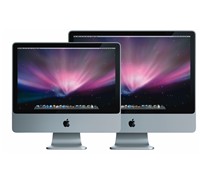
Apple Beefs Up iMac Range

Apple has powered up its iMac notebook line up with the latest Intel processors and faster graphics.

The whole range will see faster Intel Core 2 Duo processors with 6MB L2 cache and a faster 1066 MHz front-side bus, while 2GB of memory will be standard in most models. The 24-inch iMac now offers 3.06 GHz Intel processor and the high-performance NVIDIA GeForce 8800 GS graphics as options.


Click to enlarge
“The iMac’s gorgeous aluminium and glass all-in-one design has been an incredible hit with our customers and is just one of the reasons Mac sales are growing three and a half times faster than PC sales,” said Apple’s senior vice president of Worldwide Product Marketing Philip Schiller.

“With the latest Intel processors, a faster new graphics option and more memory, customers now have even more reasons to love the iMac.”

The updated iMac range includes built-in AirPort Extreme 802.11n Wi-Fi networking, Bluetooth 2.1+EDR; Gigabit Ethernet; built-in iSight video camera; a total of five USB 2.0 ports (including two on the Apple Keyboard); and one FireWire 400 and one FireWire 800 port.

RRP: from $1,599

See: www.apple.com.au

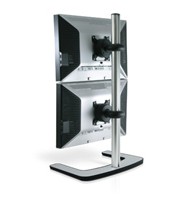
Atdec Launches 2-in-1 Screen Mount

If you are juggling two monitors in your office, but running out of desk space, the new Atdec Visidec Freestanding mounts may be a solution. They allow you to prop up two or three screens on the one device.

You have three mounting options: Double Horizontal, Double Vertical and Quad depending on your needs.


Click to enlarge
Atdec says its new range caters for the increasing number of professionals who need two monitors to work, quoting research stats from Microsoft which found two screens can increase productivity from 9 percent to 50 percent depending on the task.

“By offering these space saving mounting solutions our aim is to help resourceful professionals gain a host of productivity advantages coming from multiple screen usage in a beautifully design mount,” said Atdec managing director Jerome Green.

While the double screen options may suit graphic designers or those who need two applications open at once, Atdec recommends the Quad model for professionals using more data intensive tasks, such as those in financial markets or video editors.

The Visidec Freestanding Range has dimensions of 42 cm wide x 30 cm deep, and can be moved around the desk freely. Displays can also be rotated and tilted as needed. The mounts can accommodate monitor sizes of up to 24-inches. Cables can be concealed into the device.

RRP: from $399

See: www.atdec.com.au

Massive Demand for 19 inch Widescreen LCDs

Supply of 19 inch widescreen LCD monitor panels is now tight, with one of the world’s top producers of LCD panels, Taiwanese company, Chi Mei Optoelectronics (CMO), claiming that orders within the segment are stronger than expected.

Acceptance of widescreen displays is growing, and the 19 inch segment is now the Taiwanese entry-level segment, the panel maker said. Panel makers have estimated demand for 19 inch widescreen monitors will reach up to nine million units this year.

The 20.1 inch segment is also competing to become the mainstream widescreen size, as it has a higher resolution and allows concurrent viewing of two A4 size screens, sources indicated.

CMO’s monthly shipments for the 19 inch widescreen segment rose to over 300 000 panels during the first quarter of 2006 and the amount will significantly grow in the second quarter, the company said.

CMO will also introduce 22-inch widescreen monitor panels this quarter. The panel will have a 1,680_1,050 resolution and 5ms response times, according to sources.

CMO expects widescreen monitor panels to account for 10% of all LCD monitor panels shipped this year.

Despite soaring demand, local distributor of Chi Mei displays, Pioneer Computers is selling a 19 inch widescreen LCD monitor for under $400. The CMV 937A is claimed to have an 8MS response time, 1440 X 900/WXGA resolution and 600:1 contrast ratio.

See www.pioneer.net.au and www.cmo.com.tw/cmo/english