Smart Office

IPTV WILL Up The Ante: BBC Boss

Catch up TV will add value to television, not take it away, the head of BBC Worldwide tells an Australian audience.

The BBC’s UK iplayer, funded by British licence fees, is a catch-up model, while the global iplayer, soon to arrive in Oz, will not offer catch-up but will be a mixture of current and classic content, says the BBC Worldwide.

The iplayer, the UK equivalent to ABC’s iView, was first set up back in 2007.

The IPTV service is an internet television designed to deliver programmes and other content , although is not yet available here, is likely to be a paid-for service for international viewers.

The iplayer radio service, however, is accessible online here.

Last month iplayer upped its UK offering to include links to other channels on its network like ITV1, ITV2, ITV3, ITV4, Channel 4, E4, More 4, Film 4, Channel 5, 5, 5USA and S4C.

Users can also integrate it with their BBC Online account, which also allows access to Facebook and Twitter.

However, the onslaught of on demand services has led many to believe it could spell the end of TV as we know it although the BBC feel the opposite is the case.

“The iPlayer won’t cannabilise TV,” Jana Bennett, President of BBC Worldwide Networks and Global iplayer believes, who is the woman in charge of the global rollout of the streaming service.

BBC’s worldwide channels in Australia are UKTV, BBC Knowledge, BBC World News and CBeebies.

Instead, it will “add to audience experience” of TV and will give the medium further power, Bennett said at the Astra Pay TV conference yesterday.

And it looks like the ABC here feel the same and are seeking to integrate their iView service into new technology like iPad’s and Smartphones.

Late last year, the broadcasting house announced a  joint project with Samsung to add iView to its range of Internet-enabled televisions and Blu-ray players.


Woolies Chief To Step Down

Grant O’Brien is to take over from Michael Luscombe in September, the retail giant said today.


Click to enlarge

Woolworths Board has just announced its head honcho Michael Luscombe will step down in September.

Its Chief Operating Officer of  Food and Petrol, Grant O’Brien, will be his successor and from today, will be Deputy CEO and will work closely with Luscombe until his formal commencement date on 1st October.

Incidentally, the date will mark five years since Luscombe’s appointment as CEO, whom during his tenure achieved strong business diversification in the supermarket giant, a tripling in group earnings and sales scaling the $50 billion mark.

He was also credited with achieving 68 percent increase in shareholder returns. “The Board is deeply appreciative of the outstanding leadership Michael has provided Woolworths Limited, particular as CEO.  His 33 years of service with the company have been nothing short of exemplary.”

The new CEO in waiting, O Brien, 49, has broad experience working across the business and has proven “instrumental to Woolworths’ performance and future direction” including its liquor strategy and new DIY business in his 24 years with the giant, it said today.

 “We congratulate Grant on his appointment.  His depth and diversity of experience and strong strategic acumen has given him solid grounding to lead Woolworths into its next phase of growth,” said Chairman James Strong.

O Brien will be joining Strong on the board as an Exec Director.


He is the 12th CEO to be appointed from within the ranks of the company, Strong added.   

 “I am immensely honoured to receive this opportunity and would like to thank the Woolworths Board for having confidence in my ability to continue Michael’s legacy,” O’Brien said today.

The Woolworth’s group also own electronics retailer Dick Smith and Big W stores.

HP Send Printers To Cloud Google

Its a first: HP ePrinters can now directly print from Google Cloud…without the need for a PC.


Click to enlarge

The web- and cloud-aware printers are the first to support Google Cloud Print straight out of the box, the makers said today. 

And it also eliminates the need for a print driver or PC connection and makes it easier for users to print when anad where they want, Palo Alto based Hewlett Packard said today.

The ePrint devices will print securely from any web, mobile, or desktop app that supports Google Cloud including Gmail for Mobile, Google Docs for Mobile and Chrome OS.
It also plans to include other third-party apps. 

To make the service operational, users just need to add the email address of their Photosmart, Officejet or LaserJet Pro printer to their Google account.

“Users are rapidly migrating to web and mobile apps, and Google Cloud Print brings full-featured printing capabilities to these apps,” said Mike Jazayeri, Product Management Director, Google.


“We are excited that HP has brought the first generation of cloud-ready printers to market.  While cloud printing is possible with any printer that is connected to a PC, users can achieve a more streamlined, intuitive experience by printing directly to a cloud-ready printer.”   

Harvey Norman & Co GST Campaign A Dead Duck?

Oz retailers more expensive than online EVEN after GST difference, Federal Commission finds. And it seems moving the threshold is more trouble than its worth.

In other words GST is not the issue, it’s retailer’s high prices and lack of supply that is pushing consumers online, the body says.

Lack of goods available worldwide and not sold in Australia is nothing new, although it seems consumers have now found a way around that. 

Consumers “simply cannot purchase an equivalent product from a local supplier,” which is pushing them to look elsewhere according to findings released on Thursday.

That is what retailing stalwarts like Harvey Norman, Myer and Solomon Lew’s Just Group have been told by the body charged with investigating their claims, that the absence of GST on online goods sold here under $1000 by foreign retailers is making trading unfair.

“Based on the preliminary evidence available to date, it appears that even a large reduction in the threshold may not necessarily have a significant impact on the number of parcels not subject to GST and duty,” the Federal government backed Productivity Commission said in its latest findings.

And it seems most of the goods bought online from foreign retailers are worth under the $100 mark anyway, according to Customs data.

This puts to rest many claims by the likes of Harvey Norman, most of whose white goods and TVs would be worth well over that, and one of the original ringleaders in the GST campaign, that the loss of business to online rivals was affecting their bottom line and threatening thousands of jobs.

“The debate has moved on,” a spokesperson from Assistant Treasurer Bill Shorten office said.


The retailers campaign led by industry stalwarts including Solomon Lew, Myers’ Bernie Brooks and Gerry Harvey sought to put pressure on Canberra to introduce a 10 percent GST on all goods purchased from overseas web sites and launched a series of full page ads on Boxing Day to that effect.

These findings will put yet another spanner in the works for the retailers campaigning for introduction of GST on foreign rivals, which received a massive public backlash at what was seen as retailers’  attempts to undermine online bargain hunters.

After the public backlash, Chairman of Harvey Norman, Gerry Harvey, later admitted the campaign was done in “poor timing.”

However, keeping the  GST threshold at $1000 will come at a price for Federal coffers, and would cost government $460m in lost tax revenue and up to $610m in three years time, it also found.

The GST threshold is far higher than our neighbours NZ, at $44, as well as other nations like Canada whose limit is just $20.

However, it would be more expensive for Government to cut the tax threshold for online purchases than would stand to collect, according to the Board of Taxation.

Myer have already moved their online operation, called myfind.com, offshore to China in February which offers “great value and one-off special buys for online shoppers.”


Despite the latest findings, it appears retailers including the Australian Retailers Association, are still seeking to pursue its campaign and have asked the government for more information.

The Commission is now looking at other issues affecting the industry.

Price Wars: JB Hi Fi Slash Nintendo 3DS $298 & Notebooks

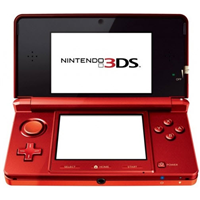
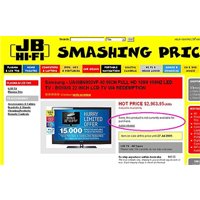
It may be April fool’s day, but these prices are no joke. JB Hi Fi has just slashed the price of the newly released Nintendo 3DS to $298 and looks to be a force to be reckoned with if market analysts are to be believed.
And Harvey’s are hot on its heels with 40 per cent off laptops.


Click to enlarge

JB have slashed the price of the new Nintendo 3DS to $298, cut by more than $50 charged by most other retailers including rivals Harvey Norman and Dick Smith (the RRP is $349).

The price also pulls the rug out from under online rivals, whose lowest price is $338 from mwave.com.au, although when shipping costs are added on the total bill comes to over $350 mark.

In fact, some online stores are charging $400 and above for Nintendo’s latest release.

And it’s not just game consoles that are going cheap this weekend.

Harvey Norman has cut 40 per cent off its Toshiba laptop range, including the Qosmio F60/05E Laptop, Satellite L650 and C650D. 

According to its website, the offer only goes on until tomorrow, Saturday 2nd.

And it’s not just consoles going cheap at JB Hi Fi, who have also cut some of its PC prices, selling Apple Macs at 10 per cent off  including the MacBook Air ($1196), MacBook Pro and iMac.

Like Harvey’s the yellow store  also has offers on some Toshiba and Samsung notebooks.  And this price battle could intensify among the major players further as soon as Harveys brings its online trading site to life, which is set to happen very soon. 

This comes as a report out today suggest JB Hi Fi will outperform the market rivals this year as the retail space continues its competitive jostle for market share. 


“JB has one of the most successful business models in the listed retail space,” according to analyst Rob Blythe from Macquarie Investments, authors of the report.

“It operates in a high growth market segment, is highly cash generative and self-funds its own expansion plans, driving its strong levels of growth.”

The company said this week it forcasts net profit for the 12 months to June to be $108.5m -$113.5m, compared with the previous forecast of between $134 million and $139 million.

This is on the back of major product releases like the Nintendo 3DS, the much hyped iPad 2 released last Friday and new TV’s by some of the major brands.

Earlier this week, JB Hi Fi shares climbed 7% after the consumer electronics and IT company announced a buyback of much as 10 per cent of its shares.

However, its not all sunny as margins, in the flat panel TV sector in particular, have slumped and performance of several of its Clive Anthony’s stores have been described as “lacklustre.”

Terry Smart, the CEO of JB Hi Fi  told ChannelNews that the restructure of the Clive Anthony operation could result in some Clive Anthony stores being rebranded JB Hi Fi while others could be “closed”. 


He also said that the company is looking at “store within a store” concepts for some locations with a JB Hi Fi store co-locating with a Clive Anthony store.

JB Hi Fi To Open Concept Stores

Its goodbye games and hello TVs as JB pulls a new trick out of the retail hat.The first store of its kind will be unveiled, starting with Sydney’s new Westfield centre on April 21st next and will feature TVs, computers but devoid of games or DVDs.

And the concept outlets could also be unleashed nationally, Macquarie analysts believe.

However, this new style of retailing won’t roll on to its mainstream stores although they may show the way to how stores will be structured in the future, CEO Terry Smart said.

 “You will get clues through that of what will make up the future JB Hi Fi stores, even though they’ll continue to have the music, movies and games content.”

But what is the exact concept? It will be a completely devoted to home entertainment and will stock brands like Sony, Apple and Hewlett Packard, according to The Australian.

The retailing giant has already been collaborating with major brands and fine tuning product displays. The stores will be product rather than price driven, believes one analyst.

And it seems concept stores are all the rage. Sony has already opened its own concept store in Westfield in the US, that delivers what it says is “a complete Sony experience.” It has also said they intend to roll out worldwide.

So, why the change of tack for JB’s?


In an exclusive interview with Channel News earlier this week, Chairman Patrick Elliott said JB Hi-Fi’s online business was growing, but admitted that its “bricks and mortar” model was “very low-cost”.

“Our cost of doing business, which is everything below the gross margin line, is about 14, 14.5 per cent of sales,” Elliott said.

“There wouldn’t be too many online retailers who have that low cost base, and so we’re comfortable that with our scale, our buying power and our low cost to business that we can compete quite effectively with an online retailer, and to that extent clearly pushing our own online model.”

“It will give us a chance to test what really works. But it’s one we don’t see a big opportunity to roll out into too many locations” Smart also said. 

The giant already said this year it planned to open 23 new stores both in Australia and New Zealand, and it is not clear as to whether any of these will be ‘concept’ locations.


And it’s not just bricks and mortar that has been keeping Terry Smart’s outfit busy. It is also looking at the possibility of  JB Hi Fi online appliance group as well as rebranding some of its Clive Anthony stores.

Back To Black: White iPhone 4 On Back Burner

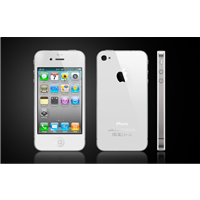
White iPhone 4 has paled into oblivion. That’s according to reports from Apple guru websites including Geek.com.


Click to enlarge

The much anticipated paler model, tipped for release in June, has done a disappearing act from the Apple website, causing fans to fear the worst.

The beleaguered iPhone 4 SKU was removed from the site displays sometime yesterday, although the other shades remain.

White, it seems, is causing the tech giant a lot of hassle and is easier said than done.

“The white iPhone will be available this spring (and it is a beauty!),” declared Phil Schiller, Apple’s VP of Marketing, last month.

However, Mr Schiller was coy about which model he was referring to, making many industry speculators believe he could have been referring to the impending iPhone 5, nicknamed ‘The Terminator’ due to tis metal casing, also tipped for release on June 20.

However,  this date could also now be pie in the sky.

Read Metal, White iPhone 5 Out June 20? here

However, the online removal could be just a temporary phenomena, while the tech giant fine tunes its whiter than white smartphone.


So Apple lovers seeking a pale colour scheme will have to make do with a white bumper accessory which is still visible in the Apple store.

Oz E-Stores Go ‘Mass Market’ But Can Retail Catch Up?

2011 is set to be the turning point for retail and the industry has JB Hi Fi and Gerry Harvey to thank. Well, sort of.


Click to enlarge

The retail mogul is setting a good example, though, believes consultants Bain & Company, who says Harvey Norman’s recent conversion to online selling will encourage others to follow suit.

His recent announcement “is the latest evidence that Australia’s retailers are getting serious about selling online and may “spur other companies (into) playing catch up,” it believes.

And it’s not just Harvey’s that has shown the road to success.

Rivals, JB Hi Fi, is one of Australia’s most successful online retail shops, with “a broad range of products and competitive prices.” The electronics giant has already said it is happy with its online performance.

And Experian Hitwise named its e-store second-most frequented online retailer here, surpassed only by electronic giant Apple.

Since the online market is still “relatively small” retailers have found vast investments directed to online “hard to justify,” say the consultants, since Australians still make less e-purchases than their counterparts in UK or US.

And retailers who still suspect online may not be all it’s cracked up to be in terms of sales potential, stay tuned.

Although in its infancy it is set to sky rocket and online sales overall will treble by 2015, to nearly $30 billion, Morgan Stanley predicts. This will only increase further with the jump in use of Smartphones and mobile tabs.

Bain & Co’s latest survey on consumers indicates the number buying online has doubled in the past year and is reaching ” mass adoption rates” and consumers plan to up their web spend.


The survey spanned all ages, incomes and locations throughout Australia.

And according to the consumer trends that emerged,  “expect increased activity in high-penetration categories such as digital content, event tickets, travel, insurance and mobile phones.”

More than half of consumers surveyed had bought digital content.  

And other hot sectors look set to be books, videos or travel services online, clothing and furniture.

So, how can retailers maximise the e-dollar? Forget about the GST campaign, for a start, warns Bain. 

The retailers campaign being referred to was led by industry stalwarts including Solomon Lew, Myers’ Bernie Brooks and Gerry Harvey have sought to put pressure on Canberra to introduce a 10 percent GST on all goods purchased from overseas web sites, claiming it was losing trade to foreign rivals. Gerry Harvey has since backed away from the issue.

“A more serious issue may be the prices that the owners of global brands have come to expect that Australian consumers will pay, and the strong gross margins that (Australian) retailers have come to enjoy.”

This has also been backed up by Productivity Commission’s latest findings that “it appears that even a large reduction in the threshold may not necessarily have a significant impact on the number of parcels not subject to GST and duty.”

More than half of those surveyed by the analysts said they shopped on overseas websites because of the price, and nearly 40 percent said that product selection or availability was the main reason.


However, Australians will shop on domestic sites if the price and product is right, Bain says.  77 per cent of those surveyed purchased on Australian websites and just 23 percent on overseas sites last.

However, retailers cant be complacent will need to invest in their online capabilities – and some may need to reduce their prices – if they are to maintain this advantage.

Secure payments and low price were identified as top concerns followed by ease of delivery, convenience while lack of online customer service was the main sticking point.

“Invest in a site that looks good and makes it easy for customers to find what they want, and don’t forget superior customer service online. “

Is Nokia Free Apps ..A Cry For Help?

It’s ‘the ‘great apps giveaway’ says Nokia. But is it a cry for help or a fantastic offer?


Click to enlarge

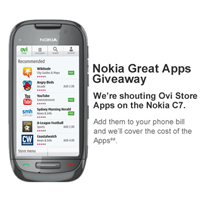
Either way, the phones giant is shouting customers who purchase its newly released C7 Smartphone free apps from its Ovi store. The apps usually cost $2 and up and it appears to be one of the only brands pursuing this strategy at present.

However, the offer appears to be available only for customers Vodafone network who sign on for a 2 year $29 contract.

“Add them to your phone bill and we’ll cover the cost of the apps” the ad states, which has been heavily advertised across several media outlets. It also offers access to Ovi Maps with free lifetime navigation and voice guidance.

Nokia’s C7, comes with touchscreen 3.5 inch AMOLED high-resolution display, 8MP camera, HD video.

The Smarthouse team  are currently reviewing the device and will return a verdict in the coming weeks.

C7 holders can access to thousands of Ovi apps until the end of May.According to Garter research, free downloads, as opposed to free
giveaways, will account for 81 percent of total mobile application store
downloads in 2011 although consumers will be willing pay more as they
become more established.

The Finnish phone giant has been struggling for survival in the new Smartphone landscape, with rivals like Apple iPhone, Android and Blackberry all eating into its market share.

However, its latest deal with Microsoft, which will see it adopt Windows 7 software on all its devices said to be worth $1bn to the phone giant, could reverse its seemingly slippery fortunes.


Android is expected to overtake Symbian and become the number one smartphone OS in Australia within the next few months, accordingto analysts IDC, although the Finnish brand did regaining the number one place in the smartphone market late last year after being overtaken by Apple the previous quarter.

However, this trend, was largely due to a sharp decline in device prices, say the analysts.