

The home business and small office sectors are leading the adoption of Cloud computing services, with business spending on Cloud services predicted to surpass $13 Billion by 2014.
 Marie Jones
Bite To Lead PR For Adobe In ANZ
PR company, Bite Communications, is to manage Adobe Systems public relations campaign in Austtalia and New Zealand following a strong quarter of growth in the consumer and enterprise technology and corporate communications markets.
The company has won a number of new clients recently, including the Australian Communications Exchange (ACE), Parallels and Greenplum.
The Bite Australia team has also been strengthened with a number of promotions and appointments. Karen O’Grady has been promoted to account director and will work across consumer and B2B campaigns. She is managing the program to promote the growth of IP telephony leader, ShoreTel, across Australia and New Zealand and into Malaysia and Singapore.
Jenny Crowcroft has been promoted to senior account manager, where she is working on deepening campaigns for consumer focused clients and building their emerging social media channels.
Bite has also appointed New Yorker, Jessica Ben-Ari as account manager to expand its capabilities in the social media environment. Jessica was previously with M Booth & Associates, a Next Fifteen company, where she worked on the consumer team for American Express on its blogger relations and online campaigns.
“There is renewed energy in the Australian communications market right now,” said Bite Communications Australia Managing Director, Roger Marshall. “Our growth in the consumer and enterprise technology and corporate communications markets has been largely driven from our local on ground resources.”
Bite’s offices in Singapore, Hong Kong, Shanghai and Beijing and strategic partners in Japan, Taiwan and India have also reported solid growth. Marshall said the company is looking to add more staff and expand Bite’s online and offline service portfolios.
Swann Launches High Res 7-inch LCD Intercom

International security monitoring and do-it-yourself video surveillance specialists, Swann Communications, has launched a colour video High Resolution Intercom that delivers crystal clear day/night images to a 7-inch LCD screen.
By utilising a pinhole colour camera that can easily be mounted in doorways, this affordable Intercom system provides 24-hour protection. It also features infrared night vision, automatically switching to black and white to enable viewing short distances in low light.
 Click to enlarge |
According to Swann’s Vice President of Global Marketing, Jeremy Stewart, the High Resolution Intercom is advancing point-of-entry security.
“Video door-phones or intercoms have proven to be extremely popular video surveillance solutions. They deliver genuine comfort to people who are worried about who they let past the front door,” Stewart said. “What this product has done is to package all the capture and display benefits of high resolution colour video technology into a neat, easy-to-use solution.”
The company’s day/night camera that comes with this solution is small and unobtrusive and connects to a High Resolution 7-inch colour monitor via the 15 metre cable provided in the kit. Once installed, two-way audio allows the user to see and talk to visitors by using simple push button controls.
A range of customisable settings have also been built into the Intercom including different doorbell tones and adjustable picture and volume settings to suit different living areas. The pack includes mounting screws, plugs and everything needed to get started. A second monitor, providing the convenience of upstairs and downstairs viewing, can also be added.
Swann’s High Resolution Intercom is available in Australia from Dick Smith and Bunnings with a recommended retail price of $299 and can be self-installed without the need for an electrician or security expert. It is also available as a special order item through Swann’s Sales Centres and Showrooms, BSR and Leading Edge.
Pure Brings FlowSongs To Aussie Music Fans
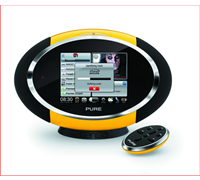
With DAB+ and Internet radio beginning to pick up speed in Australia, digital radio maker, Pure Australia today launched a slew of digital and internet radio products, to take advantage of its Cloud based music service, FlowSongs.
 Click to enlarge |
Graeme Redman, managing director of Pure Australasia, said it was the start of an exciting journey for the company and its customers, with FlowSongs providing a bridge between music discovered on digital, FM and Internet radio, and the ability to own that music.
Nearly 60 percent of the population in Australia are already exposed to digital radio broadcasts, but DAB+ broadcasts are so far confined to the five main capital cities.
Internet radio, however, which is also digital, is aiming to engender a more personalised relationship with a broader market, and can be accessed by anyone with an internet connection.
Listeners will be able to access the new service through any one of eight radios, including Sensia, Contour, Avanti Flow, One Flow, Oasis Flow, Siesta Flow, and Evoke Flow, along with the soon-to-be released Sirocco550, and future models.
FlowSongs has been available to UK listeners for some time, with Aussies now being able to buy tracks directly from the UK site, to be managed within the company’s revamped radio and media portal, the Pure Lounge, which acts as a comprehensive online music store, claimed to be the third largest music catalogue available.
Will Page, chief economist at PRS (UK) for Music, said the service can be likened to the birth of YouTube, by giving fans instant gratification, while ensuring that both the songwriter and artist get paid, which also goes some way to reverse music piracy.
The Lounge, which can be accessed at thelounge.com comprises innovative search facilities, while the store lets users buy tracks and manage playlists in a highly personalised way, while being listened to on any of the company’s digital and internet connected radio range.
Redman said the Lounge will quickly become the portal of choice for Internet media hunters.
“Effectively it is becoming the ‘Google’ of Internet radio portals,” he said.
The service is accessed by registering the Flow radio on the Lounge, and opening up an account with a credit or debit card.
When users hear the track they like, they simply select the FlowSongs option to identify the track, artist, album and price, and key in their PIN to purchase it.
In addition to being streamed off internet-connected digital radios, the songs can also be downloaded in high quality MP3 format to a PC or Mac to be added to the user’s MP3 collection.
Although being purchased from a UK site, Pure says annual subscription and individual track prices will be in line with local market rates and will depend on the publisher.
FlowSongs and the online music store will be available to Australian users from May.
Gaming Enthusiasts Drive Growth In Hard Disk Drives
Digital Video Applications by gaming enthusiasts and the ever increasing need for digital storage is fuelling the demand for gigabytes and terabytes of storage and in turn propelling the growth of Hard Disk Drive Units, according to one industry body.
The main drivers of growth have been users of notebook PCs, set top boxes and external digital storage, providing a boon for companies like Western Digital, Seagate and Hitachi.
According to market analyst In-Stat, by 2014, HDD unit shipments will increase to over 1 billion units.
HDDs provide digital storage at a tenth of the price of Solid State Drives on a cost/megabit basis.
Drive capacities are growing at a rate of 40 percent per year, and the industry is expected to cross the 1TB/sq. inch threshold by 2013.
Norm Bogen, VP of Digital Entertainment at In-Stat said: “As video has gone digital, demand for storage is found in consumer applications including set top boxes (STBs), external drives, automotive applications, personal media players, camcorders, home servers, and video cameras.”
“Set Top Boxes have been a HDD application target since TiVo pioneered TV recordings and playback and ‘Time Shifting’. The 3.5 inch HDDs at 7200 rpm and with capacities starting from 500 GBs to 2 TBs are being offered in this DVR application market.
“Among consumer applications, external HDDs are the second largest segment behind DVRs, and will double in unit volume between 2010 and 2015,” he said.
The demand for 2.5 inch mobile and potable drives is also growing at a phenomenal pace and has outstripped the total addressable market for desktop drives, according to In-Stat.
However, as companies such as Amazon, Microsoft, and Google move towards storage in the Cloud, the requirements for massive storage on a PC device will be eased, posing a possible future threat to HDD vendors.
The top five vendors in the HDD market include Hitachi, Samsung, Seagate, Toshiba and Western Digital. In the first half of 2010, Western Digital overtook Seagate as the largest manufacturer of HDDs. Seagate, however, retains its dominant position in enterprise HDDs.
Email Crosses Boundary From Web To Mobile
Email is going mobile, with more people checking their mail using their smartphones rather than via web-based browers.
A new study by ComScore found that in November 2010, the number of users accessing email via their mobile inboxes grew by 36 percent, with 30 percent of 70.1 million mobile subscribers accessing email via their smartphones.
During the same period, the number of visitors to web-based email sites declined 6 percent compared to the previous year, while email engagement declined at an even greater rate.
More people also checked their mobile emails on a daily basis. Daily usage of email grew by 40 percent as 43.5 million users turned to their mobile devices on a nearly daily basis for their email communication needs.
However, the trend points to the rapid advances of technology rather than a fundamental shift in the way email is used to communicate.
Just last week, the internet monitoring website, Pingdom, reported that 107 trillion emails were sent during 2010, most of which was Spam.
ComScore said that an increasingly complex digital environment was influencing consumers’ communication habits.
“Digital communication has evolved rapidly in the last few years with an ever-increasing number of ways for Internet users to communicate with one another,” said Mark Donovan, ComScore senior vice president of mobile.
“From PCs to mobile devices, whether its email, social media, IM or texting, consumers have many ways to communicate and can do so at any time and in any place. The decline in web-based email is a byproduct of these shifting dynamics and the increasing availability of on-demand communication options.”
The company analysed web-based email trends in the US, where more than 153 million people visited web-based email providers. In terms of engagement, overall time spent on emails via the web declined 9 percent, while total pages viewed dropped 15 percent.
Those between the ages of 12-17 showed the sharpest decline in usage of web-based email during the past year, declining by 24 percent, while engagement fell by half as total minutes decreased 48 percent and total pages dropped 53 percent.
Engagement also declined among users aged 18-54.
In contrast, usage increased among those 55 and over. The number of 55-64 year olds accessing web-based email increased 15 percent with similar gains in engagement, while those age 65+ experienced gains across all three metrics as well.
Email usage via mobile devices has however, experienced significant growth, driven largely by increased smartphone adoption.
Accessing mobile email increased by double-digits across all age segments.
Younger age groups showed a greater propensity to check emails from their mobile devices, with those aged 25-34 being 60 percent more likely to access email than an average mobile user, and the 18-24 age group being 46 percent more likely to do so.
Overall, males were 14 percent more likely to be users of mobile email.
Continued Donovan: “What we have seen in the smartphone era is the rapid acceleration of data consumption, which has helped drive mobile usage across multiple categories including email.
“In a relatively short period of time, adoption of mobile email has reached 78 percent of the smartphone population, which is very similar to the penetration of web-based email among Internet users. These findings demonstrate just how quickly channel shifts can occur and why it’s now essential for media brands to have a strong presence in both arenas.”
Qantas To Receive First B787-8 Fleet In 2012

Qantas will receive the first of 50 Boeing 787 Dreamliners – a B787-8 series aircraft – in mid-2012, two years ahead of schedule.
 |
| The Boeing 787-8 aircraft |
Qantas Chief Executive Officer, Mr Alan Joyce, said the Qantas Group had firm orders for 50 B787s in place, and remained the second largest airline customer for the Dreamliner.
“Today’s announcement confirms that the B787, with its new technologies and improved fuel efficiency, is still very much the right aircraft – for both Qantas and Jetstar,” Mr Joyce said.
“It will be ideal for point-to-point flying on medium density routes, both short and long haul and will allow Jetstar to move into southern Europe as well as build on its Asian network. It will also be suitable for Qantas services into Asia, and even for high traffic routes on Qantas’ domestic network.”
Mr Joyce continued: “The phased delivery of 50 B787s will deliver lower operating and maintenance costs, greater fuel efficiency and improved environmental performance to both airlines. The 787s will also deliver benefits for passengers with larger windows, higher humidity and a lower cabin altitude pressure improving the flying experience.”
The airline’s fleet order will comprise 15 B787-8s and 35 B787-9s. The delivery of the first eight B787-8s in 2012 will enable Jetstar’s international growth, while the remaining fleet will follow on from 2014. The new schedule allows for the transfer of Jetstar’s A330-200s to Qantas, and the retirement of Qantas’ current B767-300ER fleet. Qantas also retain the ability to purchase up to 50 additional aircraft.
Online Shopping Risky This Season
Online shopping is convenient, but risky, and the Government has issued a warning to consumers on the perils of online shopping this Christmas season.
Minister for Home Affairs And Justice, Brendan O’Connor, and the Minister for Broadband, Communications and the Digital Economy, Senator Stephen Conroy warned Australians to take some simple precautions while shopping in cyberspace and protect their personal information over the net.
Its cybersecurity website provides information for Australian internet users on what they need to do to protect personal information online.
O’Connor said: “There are precautions that consumers can take to reduce the risk of credit card fraud, such as using anti-virus software and checking credit card statements regularly.”
Simple steps to protect your computer, yourself and your family online this festive season include:
– Shopping at secure websites by researching the merchant before placing an order and saving all transaction details.
– Be wary of seasonal e-cards or emails from suspicious senders, including those described as ‘friend’, misspelled words, or strange and vague subject lines.
– Never click on links in emails from people you don’t know, even from what may appear to be trusted sources. Banks will never ask for personal details such as PINS or passwords by email
– Don’t share your full name, date of birth, address or phone number with people or sites that you don’t know or trust.
– Install security software and update it regularly. Turn on automatic updates so that all your software receives the latest fixes.
– Get a stronger password and change it at least twice a year.
– Keep an eye on what your children are doing online and encourage them to report anything suspicious.
You can also find more information on cybersecurity at www.staysmartonline.gov.au. A booklet entitled “Protecting Yourself Online – What Everyone Needs to Know” is also available from cybersecurity@ag.gov.au
PND Market On The Skids As In-Car Telematics Strengthens
A downward spiral has been forecast in personal navigation devices with the market set to halve while mobile navigation and telematics looks forward to a bright future.
A study by ABI Research says PNDs face a grim future resulting from over-inflated shipments which have created a false impression of market strength, and a slowdown in innovation.
However mobile navigation and telematics is going from strength to strength, with ABI forecasting more than 500 million downloads in 2016.
Senior Analyst Patick Connolly has called for a removal of cost barriers to customers, and to open up the OS to encourage app developers.
He said PND OEMs face tough decisions on whether to milk the PND cash cow for as long as possible or try and create a sustainable market, with secondary revenue sources such as data analytics, applications, traffic and advertising.
Many PND manufacurers have consolidated or exited the market, while others are developing new products in growing markets. These include in-car, recreational and fitness, tablets and mobile applications.
Connolly observes: “The connected PND market is forecast to represent almost 40% of all shipments by 2016. Yet, there is not enough time to allow this market to evolve organically, while ‘nickel and diming’ customers with high subscription fees.
“The existing business model must be overhauled, removing cost barriers for customers, boosting hardware platforms and opening up the OS to encourage application developers. Such measures might just accelerate uptake enough to save the overall market.”
Senior practice director Dominique Bonte adds:”Adopting this new approach will not only help to sustain the market, but will also open … areas that remain under the radar but are set to generate an increasingly large proportion of overall revenue.”
Internet First: Wedding Streamed Live On YouTube

Two billion people across the globe are expected to watch the wedding of Prince William and Kate Middleton via an official royal channel streamed live on the internet on YouTube.
 Click to enlarge |
It’s the first time a British royal wedding is to be covered on the internet, with the streaming event also accompanied by a live multi-media blog assembled by royal officials.
Google, which owns YouTube, said it was ‘thrilled” to host the coverage.
The four hour feed will be taken from broadcaster, BBC, without its commentary, with official royal staff providing live commentary and historic information, interesting links, photographs and video footage as well as a Twitter feed, said the palace in a statement.
The feed will include William and Kate’s journey to and from Westminster Abbey; the service; the appearance of the couple on the balcony of Buckingham Palace; and a military flypast.
It would be the “most digital and interactive coverage of a royal wedding to date”, the palace said.
Previously accused of being ‘out of touch’ with modern Britain, the House of Windsor is embracing the internet and social media applications in an unprecedented manner.
Fans will be able to extend their own video of congratulations to the couple on an official video “Wedding Book” on YouTube, and photographs of the wedding will be released via Flikr.
Other announcements on the day will also be published on the official wedding site www.officialroyalwedding2011.org.
Live Tweets from an @ClarenceHouse account will be integrated into the blog, and anyone wanting to send messages of congratulations on Twitter can use the hashtag #rw2011.
A social networking site Facebook (www.facebook.com/TheBritishMonarchy) has also been set up.
St James’s Palace said in a statement: “Facebook users can click the ‘I’m attending’ button on ‘The Royal Wedding’ event to show their interest in the event.”
The April 29 event will be streamed live on www.youtube.com/theroyalchannel at 7pm AEST.