Smart Office

ARA Exposes Australian Online Shopping Habits

The purchasing patterns of online consumers have been exposed by the Australian Retailers Association as it steps up the fight against lost sales to overseas websites.

Online shopping, which is rapidly being adopted by Australian consumers and sending the likes of Harvey Norman and Myers into a frenzy of competition with their overseas counterparts, is uncovering surprising shopping habits that retailers need to be aware of, says the ARA.

As expected, online book purchasing is by far the strongest category for e-transactions, with more than 30 percent of all books bought online.

Overseas websites gain large dollar purchases up to $1,000, but don’t do so well on smaller purchases, the attendees at the seminar heard, and speciality retailers such as cycle and bike shops gain most online traction from customers living far from bricks and mortar retail shops.

The seminar also heard that the next big trend in online buying might be furniture sales, as people who shop online are currently more than three times likely to buy furniture from a bricks and mortar store.

More than 150 retailers gathered at the seminar, including e-commerce experts such as Quantium, Google and Deals Direct, to figure out how to prevent the Aussie dollar from going overseas.

However, Quantium director Tony Davis said Australian retailers were losing sales to overseas websites regardless of the strength of the Australian dollar.

Australian Sporting Goods Association executive director Brad Kitschke said while industry associations have been advocating for a tax neutral competitive playing field for Australian traders, that is not the sole issue that needs to be addressed.


He urged retailers to engage in the online space and in e-tail as online shopping had become an increasing tendency for consumers across all demographics, and had moved beyond early adopters.

Yesterday Target announced it was taking its operation online with plans to extend into lines it currently does not cover. 

And in spite of all the noise made by leading retailers including Myer, Harvey Norman and Just Group over a tax neutral playing field, retailers are now moving to the web in droves to drum up sales in a flat retail trading environment. 

The ARA is  planning to address topics such as logistics and supply chain, m-commerce, social media and video in retail.
 
 A series of Engage in E-tail seminars is planned for roll out in 2011.

Gaming Interface To Push Marketing & Innovation

It’s a bold prediction, but gaming is creeping into business processes just as the social networking phenomenon before it.

Research firm, Gartner, predicts that by 2014, a ‘gamified’ service for consumer goods marketing and customer retention will become as important as Facebook, eBay or Amazon, and more than 70 percent of Global 2000 organisations will have at least one gamified application.

It also says that by 2015, more than 50 percent of organisations that manage innovation processes, will employ game mechanics to drive those innovations.

The trend has already begun in the UK and US, with the Department of Work and Pensions in the UK using an innovation game called Idea Street to generate ideas from its 120,000 workforce, and the US military using a video-game recruiting tool called ‘America’s Army’.

The World Bank has also sponsored a game called Evoke, which crowdsources ideas from players globally to solve social challenges.

According to Gartner, gamification achieves “higher levels of engagement, changes behaviours and stimulates innovation”.  As a result, the opportunities it creates for business range from having more engaged customers, to crowdsourcing innovation or improving employee performance.

The UK’s Idea Street platform, for example, included game mechanics such as points, leader boards and a ‘buzz index’ and within 18 months had appoximately 4500 users and had generated 1,400 ideas, 63 of which went forward to implementation.


There are four principal means of driving engagement using gamification, says Gartner. It increases the velocity of feedback loops to maintain engagement, it provides clear goals and rules of play, it provides a compelling narrative that engages players to participate and achieve the goals of the activity, and provides employees with short-term, challenging, but achievable goals.

Brian Burke, an analyst at the firm said: “Where games traditionally model the real world, organisations must now take the opportunity for their real world to emulate games. Enterprise architects must be ready to contribute to gamification strategy formulation and should try at least one gaming exercise as part of their enterprise context planning efforts this year.”

Gartner analysts are to explore the impact of gamification on enterprise architecture at a summit in London and San Diego from next month.


Mobile VoIP Set To Soar, Says Study

Voice over IP (VoIP) technology is spreading from the fixed line world to the mobile space, says a new study by In-Stat.

The technology that has revolutionised voice services over the past few years and has brought calling costs down for residential and business customers alike, is expected to soar beyond the $6 billion mark in 2015, says analist Amy Cravens.

“Mobile VoIP has only recently begun being implemented in the business environment.  One of the key benefits of mobile VoIP for enterprises is extending desk phone functionality to mobile devices.  Business-oriented solutions will essentially enable the users’ cellphones to become an extension of their desk phones and will deliver, in addition to voice, a unified communications experience, including email, IM, and collaboration,” said Cravens.

The study claims business mobile VoIP users will increase tenfold over the next five years, and while mobile operators are currently a barrier to adoption, they could become a significant driver of adoption in the future.

Growth in IP PBX, on which business mobile VoIp is based, will also be driven by mid-sized and enterprise businesses, the study says.


Job Seekers Turn to Technology

The hunt for a job is being revolutionised by technology, which is increasingly being used by job-seekers as a means of standing out from the crowd.

According to the BBC, a technological revolution is occuring in the world of job seeking, with recruitment agencies being squeezed out by tools such as social media.

Several potential employees are taking advantage of new ways of gaining exposure in front of future employers by posting video resumes on YouTube.

Video allows them to show off their personalities in a way that a paper CV cannot, gaining them an additional ‘wow’ factor in front of employers.

Graeme Anthony, who needed to get a job in PR, exploited the medium when he sat behind a table pitching his skills, and posted the video onto YouTube.

His novel approach was immediately picked up on by London PR agency, Frank PR, who invited him in for an  interview and awarded him the job.

Graham Goodkind, chairman and founder of Frank PR, told the BBC that he was surprised so few candidates resorted to such hi-tech tricks.

“It’s always amazed me in this day and age, that when things are moving so quickly from a technological point of view, CVs and resumes are really the same as they were 10, 15 or even 20 years ago.

“So this really opened up our eyes to how it really could be done and we wanted to meet the guy straight away.”

In addition to posting your video on networks like YouTube, job seekers are also helped along the way by a number of videos explaining better ways of marketing themselves, as wells as tips on how to make video CVs.

Fancy That: Touchscreen & Lens Control On Panasonic Lumix DMC-G3

It’s intelligent, interchangeable and incredibly compact considering it’s not a traditional point and shooter. The new Limix digital Micro Four Thirds shooter from Panasonic has a 16MP Live MOS sensor and 1920×1080 full HD video recording and comes with all the benefits of an interchangeable lens camera in one small package.


Click to enlarge

With a 25 percent reduction in size and weight from its G2 model, Panasonic’s redesign of the high sensitivity signal processing results in stunningly clear ad sharp images even when taken at high ISO sensitivity.

An articulating 3 inch touchscreen replaces the dials on the G2 giving more intuitive control of menus by touching and sliding your finger to get the desired focus, playback and effects you want. You can even trigger the shutter from the touch display.

Panasonic claims the DMC-G3’s high speed touch focusing and shooting achieves a 0.18 second speed, and mechanical frames achieve four frames per second consecutive shooting at full resolution.

Budding photographers can also get more creative by adjusting colours more intuitively, and a ‘Photo Style’ feature gives finer control of contrast, sharpness, saturation and noise reduction.

The camera body itself is made of light aluminium, and gives an ergonomic grip. It’s due to arrive in Australia in July, in black, red and white.


The DMC-G3 is compatible with Panasonic’s 3D lens, the H-FT012E. In addition to the eleven LUMIX G Series lenses, the DMC-G3 can use any interchangeable lens that complies with the Four Thirds standard via an optional mount adaptor. Adaptors for the Leica M/R lenses are also available.

A variety of touch-control operations make playback quick, easy and more fun. For example, with Touch-Scroll Playback, you simply slide your finger across the LCD to scroll through images.  And with Touch-Zoom Playback, you can simply touch a part of the image to enlarge it to as much as 16x.

Pricing and lens kits are yet to be announced.

InComm Pushes Game Cards Into Oz

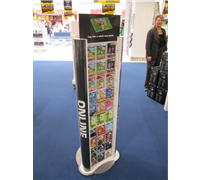
US Based InComm, has made a move into the Australian market, providing its stored value gift and prepaid cards for gaming in the run up to Christmas.


Click to enlarge

More than 800 stores linked to gaming retailers EB Games and convenience retail chain 7-Eleven will carry the digital content cards, that can be used to purchase games such as Facebook’s FarmVille and Mafia Wars, and the Disney Club Penguin, both instore and online.

Since 1992, InComm’s technology has made the buying process easier for consumers, by enabling them to purchase stored value gift cards which can be gifted to all ages, while streamlining the selling process for product and retail partners.

In the US, the company’s top tier brands can be found in top big box, grocery, convenience, chain drug, discount, electronics, office supply and other consumer retailers. Among its product range it includes pre-paid wireless airtime and handsets, digital music, ringtones and games, re-loadable debit cards, digital software and gift cards.

InComm’s push into Australia will focus on the digital content cards, and it has teamed up with Zynga, Disney and Nexon.

Next year, the company will be launching Toys R Us and Game.

IBM Slapped With $1.1M Sexual Harrassment Claim

A Melbourne woman who claims she feels ‘worthless’ and has become ‘a hermit’ after repeated claims of sexual harrassment and bullying over two years by a senior manager at IBM, is suing the global technology and innovation company for $1.1million dollars at the Australian Human Rights Commission after it failed to act on her complaints.

The once high performing sales consultant, who earned more than $159,000 per year and took home bonuses of several thousand dollars per month, suffered serious stress related illness and attempted suicide twice, according to Maurice Blackburn Special Counsel, Siobhan Keating, who is representing her case at the AHRC today.

Now in her 40s, the woman claims her senior manager, who no longer works for IBM, made sexual remarks about her, repeatedly rubbed himself against her as he walked by her work station, placed his hand on her leg and up her dress during an office function, and bullied her by being threatening and intimidating, yelling abuse, making unreasonable work demands and called her ‘stupid’.
 
Keating said: “Despite complaining to four managers, and our client’s obvious and visible distress which was affecting her performance, no action was taken for almost 18 months.

“The attitude of IBM in the face of these serious allegations, including repeatedly turning a ‘blind eye’, urging our client not to make a formal complaint, and not wanting to be told of details, exacerbated the damage to our client’s career and health and pushed our client to the edge.

The effect on the woman is said to be devastating, after losing her career and suffering from low self-esteem, loss of confidence, insomnia, anxiety and severe depression.

Keating said: “The claim in the Australian Human Rights Commission takes into account pain and suffering, the loss of future earnings as a high salaried professional, and medical expenses. Maurice Blackburn will seek to expedite the case and, if it is not resolved in the AHRC, Federal court proceedings will be promptly issued.”


Keating’s client, who wishes to remain anonymous, issued a statement in which she said:  “I just feel worthless. I feel I have no future now. I can’t get a job. I feel I’m not worth anything anymore. I was put down for so long; told I was incapable. I put IBM on a pedestal, I was proud of my job but now – nothing.

“I was always called the social butterfly and was really outgoing. Since that all happened, I just became a hermit. I don’t go out now, I’ve just been home for so long – thinking – it’s just been really hard. As much as I try [to go out], I just can’t.

“He used to scream at me every day. I did nothing wrong, and no one did anything about it – nobody.”

Keating said: “No one has a right to bully or sexually harass a colleague at work. IBM’s continued poor handling of this matter has harmed our client in the most severe of ways.

 “We allege that the conduct of the senior manager was unlawful and that IBM’s inaction was unlawful. These are serious issues that should have been dealt with immediately.
 

Qantas To Fly Daily To South Africa

Qantas has begun a daily schedule of flights to South Africa today with the addition of its seventh weekly non-stop service between Sydney and Johannesburg on Tuesdays.

The move provides Qantas customers with greater flexiility for travel between Australia and South Arica.
Qantas Chief Executive Officer, Alan Joyce, said: “South Africa is a key market for Qantas, particularly with our business travellers, and we are pleased that we can now offer customers a daily service between Sydney and Johannesburg.
“The new service will also be operated by a four class Boeing 747-400, adding an additional 350 seats per week to the route.
The daily schedule complements Qantas’ daily codeshare services between Perth and Johannesburg with South African Airways, who will also codeshare on Qantas’ daily Sydney- Johannesburg services.
Qantas continues to be the only carrier to operate non-stop services between Sydney and Johannesburg.
The new service will also deliver much needed additional freight opportunities for exporters throughout Australia and Asia on what is traditionally a sector limited by weight restrictions.
To celebrate the launch, Qantas is offering all inclusive online return fares to Johannesburg starting from $1,609 from Sydney, $1,426 from Melbourne and $1,566 from Brisbane for travel between 21 September and 30 November 2010. 
Bookings made through Qantas telephone sales may incur additional charges. The sale ends on  28 September 2010.

Qantas Opens New Airport Domestic Transfer Facility

Qantas has launched a new domestic transfer facility at Sydney International Airport that will enable faster transfers for international travellers transferring to Qantas domestic flights.

The purpose built transfer facility is said to be 50 per cent larger than the current facility and includes a spacious check-in area, six additional check-in counters, an additional bag drop area and additional seating capacity.

Similar to regular check-in at the airport, the new transfer facility will house both premium and economy check-in counters, and remains on the arrivals level at Sydney International Airport.

Qantas Group Executive Customer and Marketing, Ms Lesley Grant, said:
“Additional check-in staff and counters will ensure Qantas customers are transferred to their domestic flight quickly for passengers to meet their connecting domestic flights. An express bag drop facility will provide an even quicker transfer for customers who have their onward boarding passes and bags tagged to their final destination.”

The shuttle bus continues to operate between the international terminal and domestic terminals every ten minutes during peak times and every twenty minutes during off peak times.