PR company, Bite Communications, is to manage Adobe Systems public relations campaign in Austtalia and New Zealand following a strong quarter of growth in the consumer and enterprise technology and corporate communications markets.
Marie Jones
Pure Brings FlowSongs To Aussie Music Fans
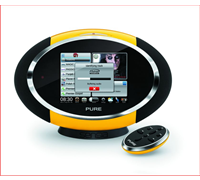
With DAB+ and Internet radio beginning to pick up speed in Australia, digital radio maker, Pure Australia today launched a slew of digital and internet radio products, to take advantage of its Cloud based music service, FlowSongs.
![]() Click to enlarge |
Graeme Redman, managing director of Pure Australasia, said it was the start of an exciting journey for the company and its customers, with FlowSongs providing a bridge between music discovered on digital, FM and Internet radio, and the ability to own that music.
Nearly 60 percent of the population in Australia are already exposed to digital radio broadcasts, but DAB+ broadcasts are so far confined to the five main capital cities.
Internet radio, however, which is also digital, is aiming to engender a more personalised relationship with a broader market, and can be accessed by anyone with an internet connection.
Listeners will be able to access the new service through any one of eight radios, including Sensia, Contour, Avanti Flow, One Flow, Oasis Flow, Siesta Flow, and Evoke Flow, along with the soon-to-be released Sirocco550, and future models.
FlowSongs has been available to UK listeners for some time, with Aussies now being able to buy tracks directly from the UK site, to be managed within the company’s revamped radio and media portal, the Pure Lounge, which acts as a comprehensive online music store, claimed to be the third largest music catalogue available.
Will Page, chief economist at PRS (UK) for Music, said the service can be likened to the birth of YouTube, by giving fans instant gratification, while ensuring that both the songwriter and artist get paid, which also goes some way to reverse music piracy.
The Lounge, which can be accessed at thelounge.com comprises innovative search facilities, while the store lets users buy tracks and manage playlists in a highly personalised way, while being listened to on any of the company’s digital and internet connected radio range.
Redman said the Lounge will quickly become the portal of choice for Internet media hunters.
“Effectively it is becoming the ‘Google’ of Internet radio portals,” he said.
The service is accessed by registering the Flow radio on the Lounge, and opening up an account with a credit or debit card.
When users hear the track they like, they simply select the FlowSongs option to identify the track, artist, album and price, and key in their PIN to purchase it.
In addition to being streamed off internet-connected digital radios, the songs can also be downloaded in high quality MP3 format to a PC or Mac to be added to the user’s MP3 collection.
Although being purchased from a UK site, Pure says annual subscription and individual track prices will be in line with local market rates and will depend on the publisher.
FlowSongs and the online music store will be available to Australian users from May.
Gaming Enthusiasts Drive Growth In Hard Disk Drives
Digital Video Applications by gaming enthusiasts and the ever increasing need for digital storage is fuelling the demand for gigabytes and terabytes of storage and in turn propelling the growth of Hard Disk Drive Units, according to one industry body.
The main drivers of growth have been users of notebook PCs, set top boxes and external digital storage, providing a boon for companies like Western Digital, Seagate and Hitachi.
According to market analyst In-Stat, by 2014, HDD unit shipments will increase to over 1 billion units.
HDDs provide digital storage at a tenth of the price of Solid State Drives on a cost/megabit basis.
Drive capacities are growing at a rate of 40 percent per year, and the industry is expected to cross the 1TB/sq. inch threshold by 2013.
Norm Bogen, VP of Digital Entertainment at In-Stat said: “As video has gone digital, demand for storage is found in consumer applications including set top boxes (STBs), external drives, automotive applications, personal media players, camcorders, home servers, and video cameras.”
“Set Top Boxes have been a HDD application target since TiVo pioneered TV recordings and playback and ‘Time Shifting’. The 3.5 inch HDDs at 7200 rpm and with capacities starting from 500 GBs to 2 TBs are being offered in this DVR application market.
“Among consumer applications, external HDDs are the second largest segment behind DVRs, and will double in unit volume between 2010 and 2015,” he said.
The demand for 2.5 inch mobile and potable drives is also growing at a phenomenal pace and has outstripped the total addressable market for desktop drives, according to In-Stat.
However, as companies such as Amazon, Microsoft, and Google move towards storage in the Cloud, the requirements for massive storage on a PC device will be eased, posing a possible future threat to HDD vendors.
The top five vendors in the HDD market include Hitachi, Samsung, Seagate, Toshiba and Western Digital. In the first half of 2010, Western Digital overtook Seagate as the largest manufacturer of HDDs. Seagate, however, retains its dominant position in enterprise HDDs.
Email Crosses Boundary From Web To Mobile
Email is going mobile, with more people checking their mail using their smartphones rather than via web-based browers.
A new study by ComScore found that in November 2010, the number of users accessing email via their mobile inboxes grew by 36 percent, with 30 percent of 70.1 million mobile subscribers accessing email via their smartphones.
During the same period, the number of visitors to web-based email sites declined 6 percent compared to the previous year, while email engagement declined at an even greater rate.
More people also checked their mobile emails on a daily basis. Daily usage of email grew by 40 percent as 43.5 million users turned to their mobile devices on a nearly daily basis for their email communication needs.
However, the trend points to the rapid advances of technology rather than a fundamental shift in the way email is used to communicate.
Just last week, the internet monitoring website, Pingdom, reported that 107 trillion emails were sent during 2010, most of which was Spam.
ComScore said that an increasingly complex digital environment was influencing consumers’ communication habits.
“Digital communication has evolved rapidly in the last few years with an ever-increasing number of ways for Internet users to communicate with one another,” said Mark Donovan, ComScore senior vice president of mobile.
“From PCs to mobile devices, whether its email, social media, IM or texting, consumers have many ways to communicate and can do so at any time and in any place. The decline in web-based email is a byproduct of these shifting dynamics and the increasing availability of on-demand communication options.”
The company analysed web-based email trends in the US, where more than 153 million people visited web-based email providers. In terms of engagement, overall time spent on emails via the web declined 9 percent, while total pages viewed dropped 15 percent.
Those between the ages of 12-17 showed the sharpest decline in usage of web-based email during the past year, declining by 24 percent, while engagement fell by half as total minutes decreased 48 percent and total pages dropped 53 percent.
Engagement also declined among users aged 18-54.
In contrast, usage increased among those 55 and over. The number of 55-64 year olds accessing web-based email increased 15 percent with similar gains in engagement, while those age 65+ experienced gains across all three metrics as well.
Email usage via mobile devices has however, experienced significant growth, driven largely by increased smartphone adoption.
Accessing mobile email increased by double-digits across all age segments.
Younger age groups showed a greater propensity to check emails from their mobile devices, with those aged 25-34 being 60 percent more likely to access email than an average mobile user, and the 18-24 age group being 46 percent more likely to do so.
Overall, males were 14 percent more likely to be users of mobile email.
Continued Donovan: “What we have seen in the smartphone era is the rapid acceleration of data consumption, which has helped drive mobile usage across multiple categories including email.
“In a relatively short period of time, adoption of mobile email has reached 78 percent of the smartphone population, which is very similar to the penetration of web-based email among Internet users. These findings demonstrate just how quickly channel shifts can occur and why it’s now essential for media brands to have a strong presence in both arenas.”
Samsung Heads For Projector Market Share
Samsung, who has been making headway in the IT and Business market, is now set to go after the projector market with a new portable projector system.
HTC Notches Up Record Phone Sales
HTC has revealed sales figures for the first half of 2010 showing record sales for the most recent three months.
Big Savings On Solar For Johnson & Johnson Staff
Energy Matters, the retail division of Apollo Energy which together with Sanyo installed Australia’s largest commercially-funded solar panel installation at Johnson & Johnson Medical’s HQ in North Ryde, is extending a special deal to the company’s employees to save money as part of the Johnson & Johnson solar project.
Sanyo Aims To Be A Hit In Clean Energy Solutions
The rooftop solar panel grid system installed at Johnson & Johnson Medical’s North Ryde HQ uses Sanyo’s unique patented HIT technology, providing one of the world’s highest conversion efficiencies, according to Sanyo’s Group Manager, Environmental Division, Paul Reeves.
Hit Technology (Heterojunction with Intrinsic Thin-layer) cells are a hybrid of two common solar cells in the marketplace, Crystalline and Amorphous, that are combined to create a more efficient and effective solar cell, said Reeves.
Sanyo HIT cells are made of thin mono crystal silicon surrounded by ultra-thin amorphous silicon layer which are claimed to provide better performance and value.
![]() Click to enlarge |
| Bill Crichton, MD of Sanyo, Maxine McKew, MP, Member for Bennelong and Paul Reeves, Sanyo Group Manager, Environmental Division |
“Using HIT solar cells enables organisations to obtain maximum power generation per square meter. With more power per square metre, incorporating Sanyo modules into clean energy solutions for homes, businesses or public facilities also means fewer rooftop modules are required, something that saves rooftop space and installation time, which in turn saves money,” said Reeves.
“The technology is getting to the point where companies like Johnson & Johnson Medical understand that the solar energy solutions they purchase will not only provide them with a reduction in their footprint, it will also be working for the next 25 to 30 years to dramatically reduce their monthly electricity bills,” added Reeves.
Sanyo teamed up with approved system integrators Apollo Energy and project management team from its retail division, Energy Matters, to install this cost-effective and highly efficient solar panel system for Johnson & Johnson, which is said to be the largest commercially funded solar panel installation in Australia.
Reeves continued: “The development of this large scale solar panel installation is truly a milestone for Sanyo, Johnson & Johnson Medical and the solar panel industry in Australia. It is the largest panel installation in the country and will save Johnson & Johnson Medical around 10 per cent of its electricity costs. The development of this installation is also a reflection of Sanyo’s place as a leading manufacturer in solar, and more importantly, a clean energy leader in the Australian market.”
Tom Tom Targets First Timers With Entry Level Via 220
Tom Tom is targeting the first time navigation user with an entry level GPS device that’s about the same size as a smartphone.
The Via 220 has a 4.3 inch touch screen with an easy to use interface and comes with cutting edge tech for smarter navigation, claims the company.
Using its IQ Routes technology, Via 220 uses eal average speed data collected from other Tom Tom user drivers, to point new drivers to their destinations using the fastest route.
It also gives advice on which lane to take at junctions, with a realistic 3D representation at difficult intersections.
Other features include alerts to fixed speed and red light camera locations on the road, as well as a Help me! Emergency menu giving assistance and direct dial through to help when on the road.
An orientation sensor on the device is also paired with a fully integrated flip screen mount, so drivers can fix the device onto the dashboard without worrying whether it is the wrong way up.
“The launch of the TomTom Via 220 means entry level GPS buyers can now benefit from superior functionality, wrapped up in a stylish, easy-to-use package,” said Chris Kearney, Vice President Marketing at TomTom Asia Pacific. “No other GPS device offers such intelligent features and good looks in a unit that is designed for the first time buyer.”
The Via 220 will be available from several retail stores around the country for RRP $199.
Sydney Joins Future Proofed IPv6 Switch On Tomorrow
Tomorrow is World IPv6 day, and if you don’t know what that is, you probably haven’t been on the Internet.
IPv6 is the new Internet addressing system which aims to be able to provide a new Internet address for every device in the home, to replace the IPv4 protocol which is running out of space.
Tomorrow, the big guns like Google, Facebook, Bing and Yahoo are turning on their future-proofed websites and two Sydney schools, Waverley College and Wollondilly Anglican College, are joining in to test the new system.
The changeover has been likened to the telephone numbering system in the 1990s, when Australia switched over to ten digit phone numbers to be able to accommodate more users.
IPv4 had 4.3 billion addresses it could share, but with many more computers, smartphones, TVs and other internet connected devices populating the consumer technology world, the need for more space on the world wide web has become apparent.
However, the changeover is not as simple as adding a few digits. Behind the scenes, hardware and software need to be configured, and Search engines, social networking sites and other big tech companies are inviting the public to log in on June 8 to put them to the test in the real world.
IPv6Now is a company assisting Australian businesses to make the transition to the new standard, and says the new system will make networking much easier because each device can have its own permanent address.
The simplest versions of IPv6 are eight sets of four characters eg 2406:a000:0000:0000:0000:0000:0000:0029 and will increase the number of possible addresses to 2 to the power of 128 or more than a trillion trillion addresses for every person now alive (officially it’s 50 octillion).
However, old IPv4 addresses won’t be shut anytime soon. Over the next few years, IPv6 sites will however become dominant, so IT administrators will have their work cut out.
Anyone can test the new sites with a piece of free software available at IPv6Now.com.au. It will help you work out if your home, business, and Internet provider aren’t ready for the new address system.