

Looks like it is not just Apple that is set to benefit from iPhone hype, spammers are doing their best to get in on the action too, according Secure Computing researchers.
 Manisha Kanetkar
Mio Launches GPS On A Budget
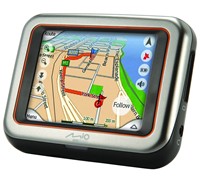
With portable GPS devices taking off in Australia, Mio has unveiled two new offerings, including an entry-level model aimed at the budget-minded.
Mio Australia National Sales Manager Peter Ferrigno said at the launch of two new devices that since portable GPS devices have become so popular in Australia, the demographic of those wanting a device is quite diverse. Accordingly the new Mio units have been designed to be user-friendly to people of all ages and not necessarily ‘tech-heads’.
 Click to enlarge |
The C220 (RRP $499) focuses on navigation functionality only, with the latest R14 Sensis mapping with over 500,000 points of interest included. Mio says the reason it is able to keep the cost of the device down is because it conducts its own research and development, manufacturing and marketing. The device features a 3.5-inch screen.
The C520 (RRP $699) offers the same mapping data and points of interest, but features a larger, 4.3-inch screen, as well as an MP3 player, Bluetooth compatibility and split-screen technology. The latter is a world first for portable GPS devices, the company claims.
 Click to enlarge |
See: www.mio-tech.com.au
Bluetooth Buying Guide For Consumers
The Bluetooth Special Interest Group (SIG) today launched the Bluetooth Experience Icon Program designed to help consumers purchase Bluetooth-enabled devices.
Bluetooth SIG said the icons will enhance the visibility of Bluetooth technology and highlight the many benefits of Bluetooth-enabled devices.
“New applications utilising Bluetooth wireless technology have gained momentum in the last year. We found it beneficial to simplify the way member companies illustrate their products’ capabilities which in turn will simplify the way consumers understand functionalities of their devices, making the Bluetooth technology experience an even easier one for everyone,” said Bluetooth SIG’s Michael Foley.
“The Experience Icons illustrate how the Bluetooth SIG is working to improve consumer satisfaction. The icons dramatically simplify the consumer buying experience based on specific applications. As a manufacturer of Bluetooth consumer products, Parrot welcomes this eye-catching way to help put Bluetooth technology into the lives of more consumers worldwide,” said Parrot Inc. President and COO, Edward Valdez.
Bluetooth SIG said that in the future, consumers can look to find all applicable icons printed on the package of a device as it is encouraging all manufacturers of Bluetooth devices to immediately begin using the Experience Icons on product packaging.
More icons are due to be released later this year, but the icons currently available to illustrate five functions of Bluetooth wireless technology are:
 |
Print – The print icon lets you know that printing can be simpler by allowing you to wirelessly print directly from your computer, mobile phone, PDA or any other device displaying the print icon.
 |
Input – The input icon shows that you can control as well as input data wirelessly to a device. This makes for fewer cables on your desk and improved control over portable devices without using the tiny, built-in keyboards.
 |
Headset – The headset icon lets you know that you have the ability to talk on your phone “hands-free.” Getting rid of annoying cables means being able to move around freely while using your cell phone.
 |
Transfer – The transfer icon tells you that the device can wirelessly send and receive data, text, pictures, music or other files with other devices.
 |
NEC Delivers Broadband Over Power-Line
NEC has launched a new broadband sharing solution that uses power-lines to deliver broadband to different areas of the home.
NEC’s Tom Sykes says the difference between this broadband over powerline solution to Home Plugs or similar devices, is that there is an extra unit which is hooked up to the power mains. The one unit can provide broadband over power at 200MB/sec to approximately 64 homes.
The benefits of this solution over DSL, says Sykes, is that people can plug it in anywhere, and it’s quick to connect. While it does have a home application, Sykes also sees the product as ideal for use at trade shows or similar events, where people need to hook up several devices, but don’t want the metres of Ethernet cabling lying around.
In the home application, however, there will also be benefits for power companies, Sykes says, as they will even be able to use the system to check the electric meter remotely.
“I think this will be a main driver for the technology,” he said.
The solution is currently being trialled in Australia, and NEC forecasts it to be more widely available within 12 – 18 months. It is not a solution for new estates, Sykes says, as there are fibre solutions for those houses. The roll out is aimed at existing estates only.
See: www.nec.com.au