Smart Office

COMMENT:Microsoft Greed Set To Screw PC Manufacturers

Microsoft love to dominate and they will walk over cut glass to achieve an objective.

This time the cut glass is their long time PC partners who they are openly looking to strip PC market share away from with their new all singing all dancing laptop and a new two in one Surface Pro 4.

Microsoft’s new marketing scenario goes something like this.

Firstly, they take their stuffed Windows OS model and move it to the cloud.

Then then offer Windows 10 free to Windows 8 and 7 customers, along the way they collect tens of millions of names address plus a vast amount of PC intelligence such as which PC a Windows 10 user is operating.
 
They then move to a new model of their Surface Pro offering which was their first real piece of PC hardware that competed with their PC partners. 

The excuse at the time was that their PC partners were not doing a good enough job of delivering Windows based tablets.

Now they have delivered a new notebook which has a hinge very similar to the highly successful Lenovo Yoga Pro 3.

They have given no reason this time as to why they believed they needed a notebook that will strip share from the likes of ASUS, Acer, Lenovo, Dell, HP and Toshiba.
 
Maybe it’s just plain simpler greed and a white hot desire to create major problems for the PC manufacturers who they are already screwing by charging them a licence fee to install a free version of Windows 10 software onto their PC.
 The charge is around $75 which is passed onto consumers by both manufacturers and retailers. 

Once that software is activated its Microsoft and not the PC manufacture who automatically gets information on the new PC owner. 

Microsoft is refusing to share their Windows 10 database information with their so called PC partners. 

A key component of Windows 10 I that consumers have to supply contact information because of “security updates”. 

Microsoft is also set to open their own shop in Sydney that will direct sell their new notebook, all in one PC, Windows 10 smartphones and various other Microsoft hardware, a store is also planned for Melbourne. 

So how long will it be before all those tens of millions of ASUS, Acer, Lenovo, Dell, HP and Toshiba customers are being direct mailed by Microsoft and told that they need a new Microsoft notebook, all in one PC or a new Windows smartphone. 
This is not a good situation for the PC industry which is already suffering as consumers switch their PC needs. 

What Microsoft is hoping to achieve is to take the top end of the PC market while forcing their competitors to sell cheap bottom end notebooks.

Two big PC manufacturers are already cuddling up to Microsoft in the B2B market. 

Both Dell and Hewlett-Packard recently cut deals to flog Microsoft hardware.

Microsoft is teaming up with Dell and Hewlett-Packard to sell the company’s Surface Pro tablet to businesses in a move aimed at stripping sales away from the specialist PC channel and mass retailers. 

As part of the partnership, Dell is now using its sales team to hawk the Surface Pro and related accessories directly and shortly, businesses will be able to buy Surface Pros directly from Dell’s website.

Financial details about the deal were not disclosed.

By partnering with other vendors to sell the tablet, Microsoft is trying to make a bigger push with corporate customers who in in the past have purchased their PC products from PC manufacturers partners. 

 Brian Hall, a Microsoft general manager of the Surface product line, told Bloomberg News that big clients have said Microsoft needed to offer better customer support for its Surface Pros before they would buy them in large quantities.

“We have had very large customers saying for you to be a standard for our employees, in the thousands and thousands of devices, we need you to have these capabilities,” said Hall. “They kept saying you are going to have to have support and services capabilities like Dell.”

When Microsoft first introduced the Surface tablet back in 2012, tech analysts took notice of the fact that Microsoft decided to develop its own hardware instead of leaving it to PC makers like Dell and HP. Microsoft reportedly kept plans of its Surface tablet under wraps from its hardware partners before the product was eventually launched. Today’s news seems to indicate that while Microsoft is still making Surface itself, it needs the help of the hardware vendors to make the tablet more business friendly.

No details were given on Hewlett-Packards involvement in selling Surface Pro tablets.
Already several PCC manufacturers have moved to expand sales of Chromebooks that are powered by Google software. Several Pc manufacturers have told ChannelNews that they will shortly offer Chromebooks complete with Free Google Docs, cloud based storage and expanded hardware capability. 

COMMENT: How Bad A Shape Is Dick Smith Really In?

A survey among vendors by ChannelNews reveals several consumer electronic vendors are now facing the real prospect that they will not get orders from the mass retailer for the Christmas New Year peak period for the simple reason that Dick Smith have a lot of capital invested in current stock that they are struggling to sell.

One major retailer said “Even now it’s too late to get current and new model stock in time for the peak Xmas period, I suspect there is going to be a lot of old stock on their shelves running into Xmas”.

Some vendors have complained of late payments with questions

being raised about cash flow at the mass retailer. Several vendors that

ChannelNews has spoken to said that they rejected overtures from Dick Smith

management to stump large amounts of upfront cash for marketing before the

close of the June 2015 financial year.

One major vendor was asked to invest $1.6M upfront, another

vendor rejected the Dick Smith offer after the mass retailer failed to deliver

any sales forecasts for his product.   

Three weeks ago Neil Merola Marketing Manager at Dick Smith

told ChannelNews that the reason that the Company had stock and cash flow

problems was because they had “ordered stock in when the dollar was

stronger” than the current $0.72 to the US dollar.

Yesterday Dick Smith shocked the market today after

confessing that it expects financial year (FY) 2016’s profits to be $5 million

to $8 million below previous guidance for full year profit between $45 million

to $48 million.

Today their share value fell a further 4.6% as investors dumped the retailers stock. 

Financial Services Company Motley Fool said that when using

the mid-point of the guidance adjustments equates to a 14 per cent profit

downgrade blamed on weak October sales which may be an ominous omen travelling

into the all-important Christmas shopping season.

The big downgrade is a blow to the credibility of management

with Motley Fool claiming that the market is mad – marking down the stock down

27%.

It was just over two months ago that the company issued

previous guidance and blamed falling margins and a weak few weeks in October

“This not going to wash with investors already nervous about the

retailer’s outlook” said Motley Fool.

Motley Fool now raises the question as to whether Dick Smith

is too cheap to ignore?

Prior to listing in late 2013, Dick Smith was part owned by

Anchorage Capital an Australian-based turnaround and special situations private

equity firm that sold its holdings for $2.20 per share.

At today’s knocked-down price of 92 cents Dick Smith is

either a screaming bargain or falling knife depending on whether it can turn

around its fortunes as a public company.

The market appears to think not given it’s now valuing the

business at around $300 million, on just 7 to 8x Dick Smith’s forecast profit

of at least $40 million for the year ahead.

Assuming Dick Smith meets the bottom end of its new guidance

of at least $40 million then profit will only be marginally lower than FY15’s

profit of $43.1 million, which suggests small improvements would lead to a

return to a growth.

The business also now offers a huge trailing yield around

13%, which is likely to decline marginally, but still be attractive in the year

ahead at whatever the adjusted level.

However, turnarounds seldom turn and the fact that margins

and profits are falling despite same store sales being up 1.3% in Q1 2016 is

another worrying sign as to the underlying health of the business.

The business is likely feeling competitive heat from rivals

JB Hi-Fi and Harvey Norman Holdings and yesterday Harvey Norman posted a strong

quarterly sales update which suggests it’s winning the battle in the electronic

goods space.

iPod Phone Confirmed

Insiders at Taiwanese phone maker BenQ say that Apple procurement executives have been talking to various Taiwanese phone makers during the past few months in an effort to cut a manufacturing deal on an iPod Phone

They say that Apple will launch an iPod with phone functions within the next few months.  “An iPod phone is definitely coming. BenQ will not be making it as we are in competition with Apple however several of our suppliers have been approached to manufacture parts. Among manufacturers in Taiwan it is common knowledge. The issue for many is the availabilty of parts if the phone takes off” said the BenQ executive.

Taiwanese electronics manufacturer Hon Hai Precision to tipped build the device, says Johnny Chan, a J.P. Morgan analyst based in Hong Kong.  “Apple still hasn’t decided whether to give the contract for what’s being referred to as an ‘iPhone’ to Hon Hai or to another manufacturer, says Ellen Tseng, a Morgan Stanley analyst in Taipei. One analyst in Taipei who declined to be identified said Taiwan Green Point Enterprises, which makes plastic cases for the iPod, is in talks with Apple for a role in the phone.”

Bill Shope of J.P Morgan believes Apple will introduce the phone by the fourth quarter of this year. Piper Jaffray analyst Gene Munster told clients last week that he estimates there to be a 75% chance that we’ll seen an iPhone in the next 12 months.

Analysts believe that if Apple does come out with a music-playing cell phone, it will likely have the biggest impact on Motorola, the leading cell phone maker in the U.S. “Even a modest showing for an Apple multimedia cellphone could put a dent in Motorola’s profits,” Barron’s says. “If Apple were to grab just 1% of the 900 million phones expected to be sold world

Sony Set To Make Big Staff Cuts After Move To DHL

Sony is set to start issuing pink slips this month following a major restructuring of their Australian operation. The move follows the appointment of DHL to handle the Company’s logistics and distribution operations.

The Company who sell into the consumer electronics, broadcast and small medium business markets are expected to lay off over 50 staff with CEO Carl Rose telling ChannelNews that the planning and evaluation process that resulted in there move to DHL was started over 12 months ago and is not a result of the economic downturn.


He said “During the past 12 months we have been reviewing our operations with a view to improving our operations and in the current environment it makes sense to constantly review costs. The move to DHL makes sense and is not a spur of the moment decision because of the economic downturn”.


Globally Sony has reported losses of over $6 billion dollars however in Australia the Company is profitable. What is not known is whether the company will merge their Computer Entertainment Division which has separate offices and separate staff in Surry Hills all for the sales of a PS2 and PS3 console, a PSP handheld and Sony games?


A Sony Computer Entertainment executive said “It would make a lot of sense but I hope they don’t as we like our autonomy and we have nice offices located close to the City”.


During an interview with ChannelNews earlier this week Rose said that the Company was set to launch several new products and that he had recently expanded his senior management team with a view to expanding sales of sony product in Australia.


He said “While the market is difficult we are constantly assessing opportunities and we will be launching several new products including new wireless Bravia TV’s, new Hi Fi and sound gear as well as high end Blu ray players. We are going to deliver high end Blu ray players as opposed to the bottom end models” he said.


On the issue of  DHL Rose said “This alliance with DHL will provide Sony with greater flexibility in managing fluctuations in the demand for warehousing. As a business, it allows us to adapt to the needs of our retail partners across the country and reflect the seasonality of the consumer electronics market, variance in product sizes and weights, market conditions and import trends.” 

Rose added that “DHL is an existing business partner of Sony and we’re confident that the extension of our relationship, by creating a variable cost platform for our logistics, will result in material and practical benefits to our business.”


In recent days Sony’s international group headquarters announced that the company would close 57 factories and shed 16,000 jobs in a bid to save around $US2.5 billion per year.

$32 A Month Apple Financed iPhone Set To Challenge Carriers

Apple is set to start financing iPhone sales a move that could force carriers such as Telstra, Optus and Vodafone to be a provider of SIM cards only and not the latest iPhone.

Currently the plan is to launch the program and if successful roll the program into markets such as Australia according to Apple sources. 

The program gives US users the option to upgrade to a new phone once a year for monthly payments starting at US$32.

Apple’s leap into phone financing gives US consumers another option to buy the latest iPhone at a low monthly cost.

Analysts estimate the Program could yield a sales boost of 5 million to 7 million more iPhones a year.


Click to enlarge

The move could free up tens of millions in cash flow for carriers while also forcing carriers to match Apple pricing.

Apple’s plan, which would allow customers to upgrade as frequently as once a year, could further fray the somewhat tenuous ties that bind subscribers to their carriers said the Wall Street Journal.

Currently most carriers in Australia demand a two year contract with hefty margins built into a combined SIM and iPhone sale.

With Apple financing phones, there will no longer be anything financially tying subscribers with the new plans to their carriers. All an iPhone user would have to do to switch carriers is get a new SIM card.

All of a sudden carriers would have to expand the marketing of their networks Vs flogging a combined sim/iPhone deal.

That could push them to respond by lowering the cost of device or service plans, effectively bringing subsidies back, New Street Research notes. This, in turn, could pressure operating margins already dinged by price wars.

And while Apple must be careful about antagonizing its biggest distributors, the move may presage more aggressive steps down the road, according to UBS.

These could include a shift to a software-based SIM, which would allow customers to switch carriers without having to open up their phones. Apple could also launch its own branded wireless network similar to Google’s Project Fi.

The Wall Street Journal concluded that when it comes to financing phones, Apple may be giving carriers a bit more help than they bargained for.

Fake Boobs And Story Stealing Land Fairfax Scribes In Hot Water

Fairfax journalists Vanda Carson and IT scribe Asher Moses have both found themselves in hot water recently, Carson for wrongly reporting that a former tech PR consultant Vivienne Dye had received a $20,000 payout for workplace bullying from her former employer Vodafone and had spent it on a “boob” job and Moses stands accused of “Stealing” stories from other technology web sites.

A well respected web site MacTalk facilitates discussion about the Apple Mac market. Visitors to the site have accused Moses of reading their site, stealing their scoops and not giving credit back to the original writer of the story.


A CNet Image


“Give us the fXXXing credit for it”, one of the MacTalk podcasters writes. “It’s stealing if you don’t give credit”. “It’s not fair”. “We just want a link” they said. When Moses tries to defend himself one contributor to the site wrote.


“If you think we are making you out to be” a plagiarist, then you don’t understand the definition of the word. When you use information, without attributing the source that’s plagiarism.


That’s not interpretation, that’s fact.  And when does the story “warrant” a link? When it’s 95% MacTalk content, or does it have to be 99%? I give you credit for actually showing up to defend yourself, but you can’t really expect us to believe you.”


This is not the first time that Moses has found himself being slammed for his actions. 16 months ago Moses had a run in with the editor of TechCrunch a local technology blog site run by Paul Montgomery. Under the headline: The Asher Moses Debacle” Montgomery wrote. A reporter from the Sydney Morning Herald named Asher Moses emailed me and said “First off, great site – I’m a regular reader of yours.” He then went on to say he’s working on a story about the “disclosure scrubbed at TechCrunch debacle.”


I took issue with his use of the term “debacle” before actually speaking to me – this tells me everything I need to know about this particular reporters slant on this “story,” and basically told him to fuck off”


For Carson the matter is a lot more serious with Fairfax and Carson facing the possibility of being sued by Vivienne Dye who found herself in the headlines last week after taking action to try and get a $1 million dollar payout from the Commonwealth Bank. She claimed that she had been harassed by the bank’s head of local business banking, Michael Blomfield, and the head of sales at the premium business services division, Angus Patterson.

News Ltd Image: Vivienne Dye in New York

Dye who is well known by the IT media and many IT vendors has worked with Vodafone, Upstream, Text 100, Burson-Marsteller and Gotley Nix Evans. Carson claimed in the SMH last week that Dye had made a claim against Vodafone for harassment and had received a $20,000 payout. Money they say she spent on a “Boob job”.


According to Vodafone this is not true and that all payments to Dye were provided as part of her normal remuneration.
It appears that Carson had not bothered to contact Vodafone to check the fact with Dye’s lawyer Peter Rochfort now looking at taking legal action against Fairfax over the claims.

A Vodafone spokesman said Ms Dye, “left of her own accord” in December 2004, saying there were no claims against colleagues on her employment record.

It appears that Carson had not bothered to contact Vodafone to check the fact with Dye’s lawyer Peter Rochfort now looking at taking legal action against Fairfax over the claims.

Target Sells 22 Inch OLED Monitor For $248

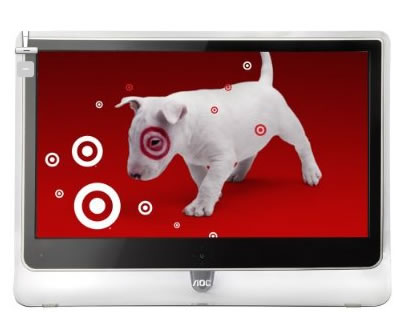
Discount store, Target, has started selling a 22″ OLED PC monitor online for just A$248.

The product which comes in a sleek light grey casing has a maximum resolution of 1920 x 1080. Target USA say that they will ship to Australia if the buyer has a US credit card or can pay via a US bank.

The screen is made by AOC.

Earlier this year Sony was trying to sell an 11″ OLED monitor for $6,999 via their Sony Central stores.

The full details are as follows.

 ·Monitor Features: Adjustable Tilt, Touch Sensitive Controls
·Maximum Resolution: 1920 x 1080
·Contrast Ratio: 2000000:1
·Aspect Ratio: 16:9
·Dot Pitch: 0.24 mm.
·Brightness(cd/m2): 250
·Viewing Angles: 160 Degrees
·Response Time: 5ms Response Time
·Audio Features: Built-In Speakers
·Input Type: Analog RGB, VGA, DVI-D, HDMI Port
·DVI-D Ports: 1
·DVI-D with HDCP Ports: 1

More Details Over page


·HDMI Ports: 1
·IEEE 1394 (Firewire) Ports: 0
·VGA Ports: 1
·Dimensions: Length: 15.5 “; Width: 21.3 “; Depth: 5.2 “
·Product Weight: 7.1 Lb.
·Warranty Description: 1 Year Limited Manufacturer Warranty

To make a purchase follow this link.


Click to enlarge

LCD TV Moving Into Over Supply

The oversupply ratio of LCD monitor panels is expected to widen in the first quarter of 2006, as the period is a traditional slow season for the segment and panel supply will continue increasing, according to Chunghwa Picture Tubes (CPT).

LCD monitor panel suppliers will start to face stronger price-cutting pressure this month due to seasonal effects, the company said.

The ratio of oversupply in the first quarter of next year will vary according to the condition of LCD TV demand, CPT said. If LCD TV demand remains strong, the newly ramped capacity at panel makers will be consumed and the oversupply ratio of LCD monitor panels will not be as significant as forecasted, the maker indicated.

Dell has been adjusting its LCD monitor inventory since late last month, with the adjustment ratio reaching 20-30%, as its previous forecast of demand this quarter was overly optimistic, CPT indicated.

Nevertheless, the range is still within acceptable limit and other customers of CPT do not have inventory as high as Dell’s (one to two weeks higher than the same period before), the panel maker said.

Most major Taiwan-based panel makers are optimistic about TV panel demand next year and have forecast that the market will rise to 42-44 million units, according to the companies. AU Optronics (AUO) expects the market to nearly double to 44 million units next year, up from 23 million this year while LCD TV demand will jump from 20 million units this year to 35 million next year.

Chi Mei Optoelectronics (CMO) also expects the LCD TV panel market to grow more than 80% to 42 million next year. The company thinks it unlikely that a serious oversupply of large-size panels will occur in the first half of next year, as the supply of certain key components may run tight.

Chunghwa Picture Tubes (CPT) estimates LCD TV panel demand will reach 44 million units and LCD TV demand will reach 36 million next year.

Market research firm WitsView Technology indicted that if each industry player reached its own TV panel shipment goal next year, the market would total more than 50 million panels. However, WitsView expects the global LCD TV panel market to reach 41 million units in 2006.

Harvey Norman And Flexigroup Slammed By Former Cabinet Minister

Flexigroup who have seen their shares crash from $3.00 to a low of 0.41c and one of their biggest retail partners Harvey Norman have been slammed by a labour party MP and former cabinet minister who has accused the retailer and their finance partner of using unethical practices to deceive customers into buying goods way beyond their capacity to pay.

According to the Age newspaper in Victoria the former state cabinet minister Christine Campbell says some vulnerable customers are being hit with interests rates on overdue credit of up to 34%. Ms Campbell, the Labor member for Pascoe Vale, said banks and finance companies were refusing to take responsibility for selling credit to shoppers who could not afford it.

Flexigroup who for more than a decade has had a financial arrangement with Harvey Norman is currentlu on the skids with their shares crashing in value during the past few weeks.

She called on the State Government to investigate the credit lending practices of the big retail chains and insist that they declare all fees and commissions.

“Credit providers are not philanthropic charities and they should be stopped from masquerading as such,” Ms Campbell told the Victorian Parliament.


“Harvey Norman credit providers are failing to perform credit checks on customers, preferring to simply hand over retail goods and a finance contract that is likely to become a millstone around the neck of the unsuspecting.”

Ms Campbell said staff at stores such as Harvey Norman were failing to tell customers the details of contracts, or the overall price of goods.

Flexigroup shares are currently trading at 0.66c