Smart Office

Dodgy Appliance Distributor Wacked With $370,000 Fine For Questionable Vacum Cleaner Sales Methods

Dodgy door to door vacum cleaner Company Lux has been wacked with a $370,000 fine by the Federal Court for unconscionable conduct following investigation into their selling practises.

The Federal Court has ordered Lux Distributors Pty Ltd (Lux) pay pecuniary penalties totalling $370,000 in proceedings brought by the Australian Competition and Consumer Commission.

The Court’s orders follow declarations by the Full Court of the Federal Court in August 2013 that Lux had engaged in unconscionable conduct when selling vacuum cleaners to three elderly women.

The sales occurred after a Lux sales representative called on the women in their homes under the premise of a free vacuum cleaner maintenance check, but with the purpose of selling a vacuum cleaner. The women were then subjected to unfair sales tactics, and pressured into purchasing a vacuum cleaner. 

“The substantial penalties imposed against Lux reflect the nature of the breaches, which involved taking advantage of a “deliberate ruse” to gain access to consumers’ homes and then engaging in pressure sales tactics so that these vulnerable consumers agreed to make a purchase,” ACCC Commissioner Sarah Court said.

“The Full Court noted in its judgment in 2013 that consumer protection laws reinforce societal values and expectations that consumers will be dealt with honestly and fairly, and without deception.”

“As the national consumer protection regulator, consumer protection issues that affect vulnerable members of the community and unconscionable conduct are priority areas for the ACCC,” Ms Court said.

The Court also made orders for injunctions preventing Lux from engaging in similar conduct in the future and requiring the establishment of a compliance and education program for all Lux employees and its agents.

Background

The ACCC instituted proceedings against Lux in May 2012. The ACCC alleged that between 2009 and 2011, Lux engaged in unconscionable conduct in relation to the sale of vacuum cleaners to five elderly consumers in contravention of section 51AB of the Trade Practices Act 1974 and section 21 of the Australian Consumer Law.

In February 2013, Justice Jessup dismissed the ACCC’s Application, finding that Lux had not engaged in unconscionable conduct during its dealings with the consumers.

The ACCC appealed the decision in relation to three of the consumers, and in August 2013 the Full Court of the Federal Court found that Lux had engaged in unconscionable conduct in respect of each of the three elderly consumers.

No Real Bidders For Dick Smith, Supplier Support Evaporates

No real bidders have emerged for the Dick Smith retail chain with both private equity firms and overseas investors failing to put in “realistic” bids for the retail chain that is now under administration.

A major sticking point has been the estimated $50M that is needed to restock the struggling chain and the exit of management to run a restructured operation. 

Insiders are tipping that a move will begin next week to start closing stores with the business set to be wound up and placed into liquidation. 

Some store leases could be taken over by other retailers these include the Move stores and some New Zealand stores. 

Another sticking point is that several large suppliers have said that they will “not” support a restructured group on the basis that the cost of servicing an additional supplier is “not worth the investment”.

A former senior Samsung executive said “The last thing Australia needs is another consumer electronics retailer. By consolidating around the likes of JB Hi Fi, The Good Guys and Harvey Norman manufacturers can cut their operational costs, reduce their exposure while building their relationship with these key retailers”. 

“The exit of Dick Smith from the market could lead to retrenchments among vendors who had heavy exposure to Dick Smith, this could include account managers and merchandisers”.  

“Another problem for manufacturers is that the Dick Smith brand is seriously damaged and there is no evidence that consumers will shop at a rejuvenated Dick Smith as a result brands like Samsung, Panasonic, Apple, Google, Lenovo and Microsoft don’t want to be associated with a failed retail brand”. 

One private equity investor, who decided not to submit an expression of interest, argued this latest turnaround at Dick Smith necessitated a “rebuild from the ground-up”.

Ferrier Hodgson management said that they want to sell the chain in one line.

Anchorage bought Dick Smith for $94m in 2012 from Woolworths and floated it at the end of 2013 for $520m. Upon its collapse, Dick Smith was valued by the market at $84m.

Acer, Lenovo To Embed 3G

Acer is to embed 3G mobile-phone technology into its future notebook PC products, kicking off with a pair of Centrino Duo-based machines, the company said this week.

The TravelMate 4260 and Aspire 5650 will both incorporate UMTS 3G and tri-band GSM/GPRS 2.5G radios to allow their users to connect to the internet across cellular networks without the need to connect the computer to a mobile phone.

Acer said the 3G radio would be updated to support higher-speed downloads using HSDPA (High Speed Data Packet Access) technology when it is offered by the mobile phone networks.

The notebooks are based on Intel’s Core Duo processors, 945PM chipsets and ProWireless 3945ABG Wi-Fi adaptors. Acer didn’t provide further specification details, or indicate when the machines will ship, or how much it will charge for them.

Lenovo also plans to introduce ThinkPad Centrino Duo notebooks featuring Vodafone 3G capabilities. The new X60 Series which includes the lightest ever ThinkPad weighing in at only 1.22kg and the T60 will come equipped with a 3G wireless antenna protruding slightly from the lid and in-built SIM Vodafone SIM card for easy connectivity to wireless broadband.

Lenovo said the new models will be available in late March, April timeframe.


Dick Smith Senate Inquiry Stopped, Claims Of A Report Misleading

Claims that the Federal Economics Reference Committee was set to release a report today into the collapse of Dick Smith has been described as misleading.

Appliance Retailer who last week claimed that they had an exclusive interview with newly appointed Samsung Vice President of Consumer Carl Rose, an interview that both Rose and Samsung, claim never took place has again run into a facts problem.

Yesterday they claimed that Federal Economics Reference Committee will today deliver a report into the Dick Smith collapse.

The only problem is that the committee was abandoned two weeks ago following the calling of the Federal Election and Double dissolution of both houses of parliament.

Former Committee members have told ChannelNews if the committee does re sit there is “no certainty” that the investigation of the Dick Smith collapse will continue.

An Economics Reference Committee executive said that the report was “misleading”.

The earliest any report could be released is September 2016″ they said.

“There is also the possibility that the investigation by the Senate committee could be axed altogether” they added.
 
Appliance Retailer claimed that the Economics References Committee has spent the last three months trying to uncover the causes and consequences of the collapse of listed retailers in Australia – Dick Smith being the most notable in recent times – with receivers calling time on the business in February this year and 3,000 people out of a job.

Scoop PiX Third Gen Motorola Razr

SHR has scored a sneak peek at the new G3 Razr. Better looking than the Mororola iTunes phone this baby will be launched either late this year or early 2006.

Motorola has got  FCC approval for a second 3G phone based on what is now called the V3x. The E1070 is a relatively slim clamshell with GMS/GPRS 900/1800/1900 and UMTS 2100. It includes many of the same features as the V3x such as dual color displays, Bluetooth (including advanced audio and printing profiles), a MicroSD (TransFlash) slot, audio player, Motorola’s new Linux / Java OS and dual cameras. However the E1070 only has a 1.3 Megapixel external camera. Motorola has not yet announced the E1070, so availability is not yet known.


Click to enlarge
New G3 Razr

SHOOTOUT: We Pick The Best All In One Touchscreen PC

One of the neat new product categories to come of age following the launch of Windows 7 is the all in one touch screen PC with several vendors now pushing new offerings. While this technology has been around for a while, it has, in the past, been clunky and ineffective due primarily to the poor performance of Windows Vista.


Click to enlarge
This was very evident in the early HP TouchSmart PC’s which were expensive and failed to deliver a good touch screen experience.

Today, PC vendors have another problem, in the form of Apple, who not only own some of the best touch technology patents in the world but have demonstrated with their iPhone and their iPod Touch that their touch screen technology actually works with it becoming the benchmark by which touch screens are judged.
 
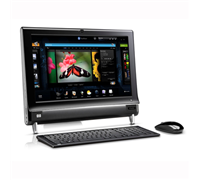
Late last month HP launched their new HP TouchScreen 300 which is a big improvement on the previous model. It is smarter and faster but it does have some setbacks.

Just as we were about to do our review of the HP offering, we got our hands on a brand new all-in-one Medion Akoya P4010D touch screen. Medion are a German company who only sells their product in Australia via Aldi stores. This is an almost identical product to the HP offering.


Click to enlarge
We decided to do a side by side review of the HP product, which comes from the world’s biggest PC company and the offering from Medion, who builds millions of PC’s for the European market and the fast growing Aldi supermarket chain, who are rapidly expanding their operations in Australia.

Within minutes of starting this review we knew instantly that there was a big difference between the two products and it was not just the price.

The HP offering had a 20.5″ screen and a maximum resolution of 1600 X 900 while the Medion had a 21.5″ screen with full 1920 X 1080 resolution which allows Blu-ray movies and FullHD media to be watched at maximum resolution.

Both PC’s came in shiny lacquer black casings with a hint of chrome around the edges and they both looked impressive. The HP is heavier than the Medion but the latter is not as stylish as the HP offering which is not surprising with Medion’s European heritage. Out of the box, the HP Touch Smart was considerably brighter when both screens were placed on their maximum display settings however the Medion did have a matte finish to their screen Vs the high gloss finish of the HP.

The first thing we notice was the difference in design with respect to the stand. A big problem emerged with the HP Touch Smart as it is rigid and doesn’t allow for much customisation of the angle you can use the PC. The Medion stand was flexible, allowing the screen to be easily set at a comfortable distance from your face but the HP stand forced the screen upright into which we found uncomfortable to use. It forced you to have to physically move the screen further back on a desk to get a comfortable position.  Attempts to set the screen further back resulted in us nearly breaking the stand. This is a major design flaw.


Click to enlarge
When it came to raw processing power, the Medion came with an Intel Duel Core 2.4 GHz CPU, while the HP offering has an AMD Athlon X3 400e processor which when operating basic functions in Windows 7 such as control panel access to the subsequent menu’s both operated on a par with each other. We then discovered that the Medion was configured with the 32 bit version of Windows while the HP model had the 64bit operating system.

Using the “rate and improve your computer performance” test that is built into Windows 7 the HP TouchSmart outperformed the Intel based Medion. Processor calculations per second, for the HP AMD PC were 6.3 Vs 5.5 for the Intel based Medion. Memory operations per second on the HP was 7.2 Vs 5.5 on the Medion.

When we loaded Photoshop onto both PC’s the access time difference was notable with the HP Touch Smart with the AMD processor performing fractionally slower.

When it came to “touch tests” the difference was very noticeable. The Medion responded significantly better. Windows on the HP machine often took two or three presses to open or close the response while the Medion was instant in 99% of the tests we ran.


 While the HP was sluggish this was not its only shortcoming. During a series of full screen tests we also noticed a significant difference. It also has trouble recognising touch commands on the very edges of the screen. In one test we opened control panel to run various performance tests via the built in Windows 7 software. The Windows on both machines were expanded to full screen as it our experience that touch panels often have a problem when windows are opened right to the edges of the display screen. With the Medion, the Windows closed every time. With the HP we had to resort to using the mouse to close the windows.

When we ran specific HP developed applications such as the TouchSmart tutorial, the touch and motion flow response was generally good however on two occasions the PC locked up and we had to reboot the system after trying to touch scroll through an image library.  The image library software also allows you to play with your photos including two finger resizing of images. The Medion didn’t have a similar feature.

With the Medion, we used a pre loaded application called Power Cinema. This allowed us to open and close images and flick through them with touch strokes similar to what we did with the HPTS. This time the application was quick and did not crash the system.

Both PC touch panels have TV tuners however when we ran the live TV configuration tool on the HP TouchSmart it took almost 30 minutes to identify the TV stations and create an electronic program guide and when it had finished,  none of the stations made sense as they mostly came up as numbers and letters.


On the Medion, which did not have a custom TV tuning interface, we used Windows Media Centre to set up our Live TV service. It took around eight minutes to search and configure over 20 stations including several new HD channels. Windows Media Centre is also available on the HP but the device encourages you to use its custom interface.

We highly recommend that if anyone wants to use their touch screen PCs to watch live TV that they invest in the IceTV electronic program guide. This configures easily with Windows Media Centre while delivering excellent information on TV programs. It also allows you to record programs from either the PC or an iPhone or iPod Touch. The Ice TV software will work on both the Medion and the HP PCs.

One area where the HP TouchSmart was a standout was in the quality of the webcam. The images were sharp and crystal clear with room and facial images extremely close the actual colours being viewed whereas the Medion webcam was grainy, with skin colours looking grey and washed out. One thing that was neat on the Medion was the motion sensor built into the webcam. This feature allows you to set it to record, if someone passes the screen when you are away from the PC.


When it came to storage, the Medion had 1TB of storage and 4GB of memory while the HPTS only had 500GB of storage and 4GB of memory. What both PCs had was good smudge technology that seemed to eliminate greasy finger marks which I half expected to be all over the screens when I had finished this review.


Click to enlarge

At the end of the day we looked at design functionality and responsiveness of the touch technology. We took into account that both machines were pitched at the home, with built in TV tuners, video playback and web cam.

A key deciding factor was price and between the two systems athere is a $700 price difference between the $1,299 Medion and the $1,999 HP TouchSmart. The Medion also won out in the design and functionality stakes particularly when it came to the design of the stands which we believe is a critical factor with an all in one PC.

The Medion also had 1 terabyte of storage Vs 500GB with the TouchSmart It also had Full HD resolution Vs simply HD ready with the HP offering. While the HP TouchSmart had a tad more speed, better webcam and host of free applications it did not add up to $700 worth of added value to warrant the HP recommended price sticker.


Score:
Medion 4/5
HP TouchSmart3/5

 

3Com Offers Uniden Cordless VoIP

Branded as 3Com VoIP phones, the 3106C and 3107C multi-line cordless phones integrate seamlessly with 3Com’s NBX IP telephony system. Based on Uniden’s cordless technology the handsets have a of up to 305 metres from the base unit and are sophisticated enough to offer mobile access to hundreds of system features.

“Recent studies estimate that nearly 50 per cent of small to mid-sized enterprises will adopt VoIP telephony in the workplace over the next several years,” said Brett Morrison, national sales manager in charge of IP products and business communications at Uniden. “Uniden understands that innovative mobility solutions will be a substantial driver for this transition, and we are pleased to work with 3Com Corporation to offer mobile IP solutions that will expedite this transition.” 

“The 3Com NBX IP telephony system has a history of leading the market with cost effective solutions for small and mid-sized businesses,” said Greg Zweig, 3Com senior product manager.  “By marrying Uniden’s expertise in the cordless arena with the 3Com IP platform, we are offering the industry’s first multi-line cordless IP phone for small and medium-sized businesses.  Our combined expertise offers our customers a more productive working environment.  3Com continues to take steps towards delivering secure, converged networking solutions for communications platforms and business operations.”

EXCLUSIVE: Harvey Norman Franchisees Face Similar Fines To HP, ACCC Investigates Other Brands

Eleven Harvey Norman franchisees, who saw a massive $3M fine handed out to Hewlett Packard on Friday for misleading consumers, face the prospect of similar $1.1M fines from the Federal Court after being linked to the HP case by the Australian Competition & Consumer Commission.

Shortly before ACCC investigators started to investigate the actions of Hewlett Packard, the ACCC had started an investigation into the actions of several Harvey Norman retailers, who they claim engaged in similar practices to Hewlett Packard.   


The ACCC alleges that between May 2011 and June 2012, sales representatives at the Harvey Norman franchisees made misleading representations to specific consumers about the existence or effect of their consumer guarantee rights. ChannelNews understands that some of these claims relate to warranty claims involving Hewlett Packard computers.


Recently, the ACCC laid several charges against the 11 Harvey Norman franchises. 


ChannelNews understands that several other manufacturers and distributors of IT and consumer electronic goods are currently under investigation in Australia, with the real prospect they will also face ACCC charges.


The ACCC has told ChannelNews that it is conducting investigations similar to those into Hewlett Packard, into other large manufacturers and retailers, and that several manufacturers are in their sights over warranty claims.


Adrian Kuti and Matthew Battersby, lawyers for Australian legal practice Clayton Utz, claim that the ACCC’s proceedings against Hewlett Packard and the Harvey Norman franchisees are by no means the end of the drama over warranties for manufacturers and retailers alike.


They claim that further enforcement proceedings appear inevitable, particularly given the ACCC’s stated intention to take on more cases, even where the outcomes may be less certain.


In a note to clients, the lawyers write: “It is interesting that the ACCC chose to commence pecuniary penalty proceeds against the Harvey Norman franchisees, where in the past, it may have instead issued infringement notices for this type of conduct. This is a sign that the ACCC is stepping up its focus on ACL compliance and is becoming more proactive in commencing proceedings against manufacturers and retailers for alleged ACL contraventions.”


They claim that the allegations in the proceedings against Hewlett Packard and the 11 Harvey Norman franchisees highlight practical issues about the relationship between warranty claims and ACL claims and how they are communicated to customers by retail and call centre staff.


In a direct warning to manufacturers and retailers, the lawyers claim it’s important to ensure customer-facing staff are properly trained and do not, for example, confuse the requirements which apply to the return of defective products with those that apply for “change of mind” returns. 


The nature of manufacturers’ warranties and in-store returns policies as being additional to, rather than in place of, consumers’ rights under the ACL consumer guarantees regime is another key distinction that businesses must ensure their staff understand.


ACCC Chairman Rod Sims said: “Consumers have rights to certain remedies from retailers and manufacturers when goods fail to comply with the consumer guarantee provisions, including that goods are of acceptable quality and fit for the purpose for which they were sold. These rights cannot be excluded, restricted or modified.”


Nine of the Harvey Norman franchisees are:


Avitalb Pty Limited, located in Albany, Western Australia

Bunavit Pty Limited, located in Bundall, Queensland

Camavit Pty Limited, located in Campbelltown, New South Wales

HP Superstore Pty Limited, located in Hoppers Crossing, Victoria

Launceston Superstore Pty Limited, located in Launceston, Tasmania

Mandurvit Pty Limited, located in Mandurah, Western Australia

Moonah Superstore Pty Limited, located in Moonah, Tasmania

Oxteha Pty Limited, located in Oxley, Queensland; and

Salecomp Pty Limited, located in Sale, Victoria.


“While the ACCC does not allege that Harvey Norman Holdings Limited is involved in making of these representations, the fact that the allegations made by the ACCC relate to a number of its stores in widespread locations across Australia is of great concern to the ACCC, and I expect to Harvey Norman too,” Mr Sims said.

New Mouse From Apple

After 21 years of the same old boring mouse Apple has finally woken up to the fact that users need more functions and have introduced a multi button device.

The New Apple Mouse

Apple on has introduced its first multi-button mouse in nearly 21 years after debuting the one-button mouse that made the Mac famous.

Dubbed Mighty Mouse, the Mac- and Windows-compatible input device offers users four programmable buttons and something Apple calls a “Scroll Ball,” essentially a scrolling wheel that lets users browse through long Web pages or large photos vertically, horizontally, or diagonally.

“With Mighty Mouse, we’ve simply built a better mouse,” said David Moody, Apple’s vice president of product marketing, in a statement.

Programmable mice, and scrolling wheels that move in more than one direction, however, are not new; they’ve been around the Windows world for years.

Although the new mouse boasts four programmable buttons, it looks like a uni-button device. Four touch-sensitive areas under the shell respond to pressure to act as the “buttons.” Some of the areas can be programmed to give users one-click access to Mac OS X 10.4.2 (Tiger) features such as Spotlight or Dashboard.

“Mighty Mouse adds functionality while retaining the elegant, easy-to-use Apple design,” said Moody.

The USB mouse is due in Australia soon. It works with Mac OS X, Windows 2000, or Windows XP systems.

Tabcorp Facing A Rough Time Ahead At Jupiters

COMMENT: It’s amazing how the Australian tourism industry who has powerful lobby groups expect Federal and State government to bail them out when there is a market downturn or when tourism is taking a downer because visitors who have been here before refuse to come back or alternatively have told their friends that Australia is expensive and delivers “lousy” service for the price they are asked to pay.

The bottom line is that overseas tourists are not coming back to Australia not because of the beauty of the Country but because of high costs and poor service by hotel operators who want to charge premium rates but fail to deliver the quality of service that many of the visitors get in their own Country.

Almost every tourism research study identifies service as a major issue. A classic example of poor service is Conrad Jupiter’s on the Gold Coast which is often promoted by Tourism Australia and the cQueensland government as being a premium property.

Owned by Tabcorp who describe themselves as Australia’s “premier gambling and entertainment group”, this property is fast going downhill and despite an injection of capital to tart up what is fast becoming a tired four if not three star gambling property the hotel is failing to deliver even the most basic of customer service.


I have just come back from 3 days staying at this property and if my experience is anything to go by tourists are in for a very rocky ride. While gambling and the goughing of money into pokie machines or other gambling activities is a high prioity for Tabcorp it appears that customer service is suffering because of high staff turnover and poor customer service systems. 


Talk to any major hotel group, in particular the European and US operators and they will tell you that one of their most valuable assets is their customer database in particular the profiles they keep on the likes and dislikes of their frequent visitors. When I arrived at Conrad Jupiter’s I was told that they had no customer profile this is despite the fact that I have been staying at this property since first opened the last time being 12 months ago. I have done function after function in their ballroom while also booking hundreds of guests through the property for past clients.


When I checked in late on Friday night after booking directly with the hotel and after specifically asking for a King Sized bed my wife and I found ourselves in a twin room. When we pointed this out the response from the front desk operator was “Sir you did not book a king sized bed”.


Maybe he should have asked first what I had booked before telling me what I had not booked. This is called customer service.  Then when they did find a room with a king sized bed we discovered it was in a smoking room where everything in the room smelt of tobacco smoke. It then turned out that a non smoking was not available till late the next day.


Then there was the issue of room and floor keys. Eight times I had to go to reception where after waiting in a queue they had to re code my room key. They blamed my phone, then my wallet and other credit cards as the being the culprit for wiping the card of information.This is despite the fact that several customers were complaining of room key swipe problems.


In today’s market and with the technology there is available these issues can be avoided and should be avoided. This hotel is a classic example of what Tourism Queensland puts up as a 5 star hotel to overseas guests but in reality it is struggling to deliver a 3 star service.


One of the core problems for Conrad Jupiter’s is staff churn, which is uncommon among hotel properties in Australia. Speak to any of the staff at Jupiter’s and they will tell you that they are under paid and that there is high staff turnover. A check by SmartOffice reveals that staffs at Jupiter’s are paid up to $100 a week less than their counterparts at Star City which is also owned by Tabcorp and during the next few months this could well lead to further problems as staff seek further pay rises.


Service and the building of a close relationship with customers are critical in today’s market. As an example I am a regular visitor to both the Westin in Irvine in the USA and the MGM Grand in Las Vegas and at both properties they not only hold extensive customer profile but communicate with me on a regular basis with offers and information that they believe could be relevant to me.


2 years ago when I was checking into a hotel in Europe the concierge said “Welcome back Mr Richards, your non smoking aren’t you”. I had not visited this hotel for two years. Inside they knew my room preference and pillow preference and the fact that I wanted a copy of the Financial Times in the morning.


For a hotel like Jupiter’s this level of customer service is essential particularly as this hotel is now very tired and is about to lose their ocean views to new developments who will take customers away from them because they are newer, have great views and are going to be committed to not only wining customers away from Jupiter’s but retaining them with a higher level of service.       

Maybe one solution for the Federal Government is to invest in “Service” software for the tourism industry and better training for key staff instead of blatently proping