Smart Office

Finally Microsoft Discovers That Sex Sells

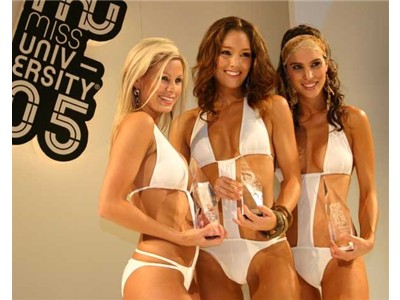
Move over Bill Gates the geek look is out. Microsoft has instead turned to the curves of former former Miss Australia Erin McNaught, an effort to change their staid IT image.

Desperate to attract people to the Company Microsoft is now using the catwalk model to turn heads following a 38 percent drop in university enrollments in IT courses in the past two years.


Click to enlarge
Former Miss Australia Erin McNaught pictured centre is the new face of Microsoft.

They believe that by investing in the curves of McNaught that they will attract the right sort of talent to the Company. According to Microsoft Human Director  Rose Clements a view among young people is that the IT industry is “not one of the sexier professions”,

The 25-year-old bombshell, who hosts gaming and gadget shows admits that she is no computer whiz. Just a great body and mind.

Microsoft kicked off the campaign yesterday on the Gold Coast during a student day at Microsoft and the Australian Information Industry Association’s annual technical education conference.

The model, who dropped out of the Queensland University of Technology to pursue her fashion career, said she most enjoyed the gaming and gadget side of the computer industry.

TFT Monitor Shortages Hurting Vendors

Several vendors are suffering from a lack of stock in the large size TFT monitor market in Australia. The problem has been caused by a spike in global demand, particularly for over 19-inch monitors.

Shipments of large-size TFT LCD panels totaled 34 million units in July 2007, up by 2.1 percent from 33.3 million units in June, according to Displaybank.

Among large-size LCD panels, monitor panel shipments were down slightly from June to 15.7 million units in July, while TV and notebook panel shipments increased on month to 7.2 million units and 10.2 million units, respectively, the research firm noted.

By supplier, Samsung Electronics retained production capacity and thus took the top position by shipping 7.2 million units since its eighth-generation (8G) line came on board. Samsung Electronics, which has focused on TV applications so far, also ranked top in revenues. The second player was Taiwan-based AU Optronics (AUO), which shipped 7 million units. Next was LG.Philips LCD, which recorded shipments of 6.7 million units.

On a revenues basis, Samsung Electronics maintained its number one position with a 22.8 percent share, followed by LG.Philips LCD at 20.5 percent and AUO at 19.3 percent.

JB Hi Fi ThinksSmart

JB Hi Fi has cranked up it’s relationship with WA Company ThinkSmart. The move comes as the consumer electronic stores reports record growth.

According to Business News in WA JB Hi-Fi and retail financial solutions provider ThinkSmart Ltd have cemented their relationship after ditching a termination by convenience clause from their operating agreement.

The clause enabled termination by convenience after the initial 24 months, but since contracting in February this year, the businesses have expanded their relationship rapidly in Australia and across the Tasman.

ThinkSmart’s product offering extended to JB Hi-Fi’s Clive Anthony’s stores and is due to roll out to its New Zealand stores by the end of the year.

The roll out in Clive Anthony’s will extend ThinkSmart’s current reach in the group to 57 stores, with a further 21 stores to come online by early full year 2008, as JB Hi-Fi completes the introduction of computer categories across its branded stores.

ThinkSmart managing director and chief executive Ned Montarello said the electronics retailer was making an impact into the computer retail space in Australia.


“We’ve already witnessed trading performance at the upper end of expectations together over our first six months of business and are looking forward to continuing to support JB’s aggressive growth in the market through our RentSmart product,” he said.

JB Hi-Fi chief executive Richard Uechtritz said getting the right partners helped him concentrate on the day-to-day growth goals of the business.

“ThinkSmart has been a great addition to our growth and provides a strong value proposition for both our customers and shareholders,” he said.

“The show of confidence in extending the agreement reflects this.”

Digital Camera Sales Up Margin Erosion Hurting

Digital Camera sales are still strong with Canon, Pentax, Nikon and Sony fighting out for share in a market where margin erosion has bocome a serious issue for vendors and distributors.

Digital camera unit sales were up 20 percent through the first half of 2007 vs. the same period in 2006 thanks in large measure to repeat buyers, according to The NPD Group.

The category grew 9.5 percent in dollars during the first half as well, NPD noted.

Over half the market (54 percent) consists of consumers on their second or more camera vs. 46 percent last year, NPD observed. Half of repeat purchasers were adding, not replacing, cameras in the household.

Average selling prices (ASP) continued to decline, dropping 13 percent to $320 during the first half of 2007. Digital SLRs also dropped, falling $125 in price to an average of $970.

The rising tide of digital camera sales has also floated accessory sales, NPD reported. Flash-memory cards saw a 46 percent unit gain during the first half of the year; camera cases were up 16 percent, while zoom lenses were up 57 percent in units.

Digital cameras have become popular gift items, NPD observed, with one in five models purchased through the first half of the year destined for gifting.

Ingram Micro AP Grows 36%

Ingram Micro which is set to roll out a Pro AV and consumer technology division in Australia over coming months has reported double-digit gains in its third quarter sales and net income. A big contributor to this growth has been the performance of the Australian and Asia Pacific divisions.

Asia-Pacific sales were $1.86 billion (22 percent of total revenues), an increase of 36 percent versus the $1.36 billion reported in the year-ago quarter. The translation impact of the relatively stronger regional currencies had an approximate 12-percentage point impact on comparisons to the prior year.

Worldwide sales were $8.61 billion for the third quarter, ended September 30, a 15 percent increase over the $7.51 billion posted in the year-ago period and an all-time record for a third quarter. The translation impact of the relatively stronger foreign currencies had an approximate five percentage-point positive effect on comparisons to the prior year, Ingram said.

Third-quarter net income increased 24 percent to $72.4 million, compared with $58.5 million in the prior-year period.

“We’re pleased to deliver another record-breaking quarter,” said Gregory M. Spierkel, CEO. “Our record sales were driven primarily by robust growth in Asia-Pacific and Europe. North America and Latin America operations both posted meaningful revenue growth, consistent with investments in expansion initiatives.”

North American sales were $3.50 billion (41 percent of total revenues), an increase of 4 percent versus the $3.37 billion reported in the year-ago quarter. As described in the first six months of this year, warranty sales on behalf of vendors are now recognized as net fees, rather than gross revenues and cost of sales as reported in the prior-year period, which had an approximate four percent negative impact on year-over-year sales comparisons, the company said.

Worldwide operating income was $111.0 million, or 1.29 percent of revenues, as compared to $93.8 million or 1.25 percent of revenues in the year-ago quarter. North American operating income was $55.4 million, or 1.58 percent of revenues, versus $55.3 million, or 1.64 percent of revenues, in the year-ago quarter.

Toshiba Stumbles But Still Hits Big Profits

Plunging TV prices and the battle over HD DVD Vs Blu-ray have hurt Toshiba who has reported a 28 percent drop in its second quarter profit. Also contributing is one-time expenses for property value calculations that offset solid sales in computers and chips.

Despite this Toshiba raised its full-year profit forecast by 50 percent, beating some analysts’ estimates, on a one-time gain and demand for semiconductors used in mobile phones and portable music players such as Apple Inc.’s iPod.

Toshba earned $219.2 million for the July-September quarter, down from 34.79 billion yen the same period the previous year.

Quarterly sales rose 18 percent to 2.025 trillion yen ($17.73 billion) from 1.709 trillion yen a year ago.

Toshiba said sales rose in televisions, but plunging TV prices hurt profit. Price erosion also hurt its business in computer chips, called memories and system LSIs, used in digital cameras, portable players and other gadgets.

Personal computer sales contributed to profit, as did the addition of U.S.-based nuclear power company Westinghouse into the Toshiba group, which lifted overseas sales of power plants and equipment.

Net income will probably rise 31 percent to a record 180 billion yen $1.6 billion in the year ending March 31, Toshiba said today, exceeding the 161.3 billion yen average of 15 analyst estimates compiled by Bloomberg. The Tokyo-based company in April forecast annual earnings of 120 billion.

Toshiba, Japan’s biggest chipmaker, also raised its revenue and operating profit estimates on sales of chips. The company is closing the gap with leader Samsung in semiconductors, which account for more than 40 percent of operating income, by focusing on smaller, more cost efficient chips and speeding up production.

“Toshiba appears to be relatively successful in its choice of businesses to focus on,” said Fumiyuki Nakanishi, a strategist at SMBC Friend Securities Co. in Tokyo.

The company in June said it is speeding up plans to increase production of flash chips by about six months to meet demand from mobile-phone makers. The chipmaker will process 60,000 wafers a month, compared with its original target of 35,000, at its fourth plant in Yokkaichi by the end of June 2008. That compares with a previous schedule for the quarter ending December 2008.


Toshiba said the outlook remains uncertain, citing worries about the future of the U.S. retail market and the subprime mortgage crisis. The U.S. economy is a major market for Japanese electronics companies.

But the Tokyo-based manufacturer revised upward its outlook for the full fiscal year through March 2008 because of income expected from the sale of its downtown Tokyo building in the second half.

Toshiba expects a profit of 180 billion yen ($1.58 billion) for the fiscal year, up from the initial projection for a 120 billion yen ($1.05 billion).

It is forecasting 7.8 trillion yen in ($68.3 billion) annual sales, better than the earlier 7.5 trillion yen ($65.67 billion).

Toshiba also makes various electronics products, including refrigerators and washing machines. Like other Japanese makers, it took a battering in recent years from cheaper rivals but has been reshaping its operations.

For the six months through September, Toshiba’s profit improved 18 percent to 45.66 billion yen ($399.8 million) from the same period the previous year. First half sales climbed 17 percent on year to 3.690 trillion yen ($32.31 billion).

Toshiba holds a 77 percent stake in Westinghouse, based in Monroeville, Pa. Toshiba bought Westinghouse from the U.K.’s British Nuclear Fuels PLC last year for $4.2 billion.

New Eee PC Set To Be In Short Supply

Asus, which is today set to roll out its new Eee PCs in Australia, has admitted that stock may be in short supply due to “serious shortages”.

In some countries Asustek Computer has pushed back the launch of its Eee PCs because of the shortage of the popular low-cost notebooks, according to Benson Lin, president of the company’s Asia Pacific and Taiwan business unit.

Lin said Asustek originally planned to introduce Eee PCs in 15 more Asian markets in November, but the shortage has prompted the company to postpone the launch dates towards the end of the year for 10 of the countries.

Eee PCs are currently available in Taiwan, China, Hong Kong, Singapore, Thailand, New Zealand and Australia, and the low-cost systems are expected to hit the Japanese market in the first quarter of 2008, according to Lin.

He said the company aims to ship 20,000 Eee PCs in Taiwan this month, with the new system expected to account for half of the company’s entire notebook shipments to Taiwan for the fourth quarter.

Lin said strong demand has been coming from the insurance, securities, realty and supplementary education sectors. Local retail channels have reported a turnover rate of only one day for Eee PCs, meaning the systems are sold as soon as they hit store shelves, Lin added.

Asustek introduced its first LED-backlit notebook, the 11-inch U1F, in March 2007.

New HD DVD Toshiba Read Write Notebook

Despite a HD DVD setback Toshiba has introduced a laptop computer that can read and record HD DVD discs. It is the first of its kind and ideal for both a home and office enviroment.

The news ahead of the International Consumer Electronics Show came two days after Warner Bros. Entertainment said it would stop offering its movies in HD DVD, choosing instead to stick with a competing high-definition video format, Sony Corp.’s Blu-ray. The announcement dealt a potentially fatal blow to HD DVD, which has been championed by Toshiba. Toshiba makes practically all HD DVD players.

Toshiba’s Qosmio G45-AV690 is powered by an Intel Core 2 processor and the Windows Vista operating system. Its 17-inch display offers resolution of 1080p, the highest currently available. The laptop also features 320 gigabytes of hard drive space, a remote control and a fingerprint reader.

The  laptop comes with a mail-in offer for five free HD DVD titles through Feb. 28. Only two major U.S. studios now support HD DVD, while five support Sony’s Blu-ray disc.

Harvey Norman Gets Serious About Taking On OfficeWorks

In an effort to expand its share of the stationery and computer market Harvey Norman has selected Pronto Software to launch a new business venture called Harvey Norman OFIS, a stationery and computer chain designed to take on Officeworks.

Harvey Norman will implement Pronto Software’s leading ERP solution, PRONTO-Xi, to provide a complete end-to-end solution to meet all of Harvey Norman OFIS’ front and back office requirements, from online sales and purchase orders to fulfilment, distribution and financial management.

Harvey Norman OFIS will be operated and managed as an independent operation under the direction of General Manager, Paul English.

Mr English said, “We chose Pronto Software to be our IT partner in this venture because it was a cost-effective, flexible, out-of-the box solution that would also ensure speed to market. Pronto Software showed they could work within our timeframes, and, like us, is a very customer-focused company.

“To be relevant in this market, you have to have an online presence. We want to ensure our online offering is equal to – if not better – than our competitors. The customer experience is paramount, which is another reason we selected PRONTO-Xi as it provides a user-friendly web-based shopfront to easily shop online.


“We referenced Pronto Software customers and liked what we saw in terms of the volumes and complexities that Harvey Norman OFIS will be dealing with. We’re very confident Pronto Software is the right solution provider to move forward with in this exciting venture,” Mr English said.

Harvey Norman OFIS has initially purchased 60 user licences to support head office and the first two stores, utilising a range of PRONTO-Xi modules including Financials, Distribution, Warehouse Management, Point of Sale, CRM, EDI, and iShop.

The Harvey Norman OFIS online store is scheduled to go live in the first half next year, while the first two ‘bricks and mortar’ stores – in Albury and Auburn, Sydney, will open in March. Harvey Norman plans to open eight to 10 stores by the end of the year.

Pronto Software Managing Director David Jackman said, “That one of Australia’s biggest retailers has chosen Pronto Software’s platform to launch its next venture validates our expertise to address sophisticated retail business needs.


“Not only were we able to demonstrate that PRONTO-Xi is technically a superior ERP solution than our competitors, but also the best-fit supplier in terms of our customer focus and practical approach. We look forward to working with Harvey Norman on the successful launch of Harvey Norman OFIS,” Mr Jackman said.

English said the Pronto Software team has been great to work with. “There’s been very little red tape and not a lot of management tiers to get through. Pronto Software is working with us at a grass roots level and these cultural synergies have been a benefit given the aggressive timeframes.”

Pronto Software’s growing community of world-class retailers include Haymes Paint, Jessops, Kathmandu, Photo Continental, Snooze and The Body Shop.