Smart Office

Palm To Launch Laptop Device

Palm is set to launch a small laptop-like device with large screen and full-size keyboard to read and edit emails and documents residing on Bluetooth-connected PDA phones.

The Linux-based Palm Foleo, dubbed a mobile companion, uses Bluetooth to synchronize data with a PDA-phone and to send and receive email wirelessly via the PDA-phone’s cellular radio. The instant-on solid-state device, which lacks hard drive, is targeted mainly to heavy wireless email users, who can also opt to send email and browse the Web via Foleo’s built-in Wi-Fi.

Palm claimed the device would “establish a new category of personal-computing products” and would ride the wave of PDA phone and smartphone popularity.

Out of the box, Foleo will work with Palm Treo PDA phones based on either the Palm or Windows Mobile operating systems, but Foleo is also expected to work with all other-brand Windows Mobile devices, said Palm founder Jeff Hawkins. Palm also plans to support RIM BlackBerries and Symbian PDA-phones smartphones, although it wasn’t certain clear whether the BlackBerry and Symbian support would be available in time for the device’s summertime launch.

The device is expected to retail for $699.

For that price, consumers would get one-button access to full-screen email, 10-inch screen, Web browsing via Bluetooth or Wi-Fi, and DataViz’s Documents To Go application to create and edit Word-, Excel-, and PowerPoint-compatible documents. The Foleo also includes a Palm-developed PDF reader. Edits made on Foleo automatically are reflected on its paired smartphone and vice versa.

The device’s battery lasts for five hours with Wi-Fi activated, Hawkins said. Standby time is about a day. Users can turn the Foleo off without closing applications or saving documents. All work is automatically saved when the device is turned off. When Foleo is turned on again, the device resumes where the user left off.

Foleo lacks a mouse but features a scroll wheel accessible with either thumb when the user’s hands are on the keyboard. It has an external SD Card slot and internal CompactFlash slot.

Palm said it is actively supporting third-party software developers.

Hello Moto..It’s Me I’m On The Top Of Everest

Motorola has scored a world first after a British climber became the first person to make a mobile phone call from the top of Mount Everest.

Mountaineer Rod Baber, 36, removed his oxygen mask to make two calls from the mountain’s north ridge. In the first call to a special answerphone set up by sponsors Motorola he said: “It’s amazing. The Himalayas are everywhere.”

Mountaineer Rod Baber,

The feat was made possible by China Telecom which set up a base station at Rongbuk, about 8km from their base camp and 16km  from the summit.

Telecommunications on the mountain had been restricted to shortwave radio, which has a limited range, and satellite telephones, which are expensive and can be disrupted by bad weather. Before radio the best form of telecommunication on Everest was Morse code, transmitted between base camps along copper wires laid by the ill-fated Mallory-Irvine expedition of 1924.


The advent of relatively cheap mobile telephone calls on the world’s highest mountain marks another milestone in the relentless expansion of cellphone networks around the globe. While some may lament the mobile’s intrusion into one of the planet’s great wildernesses, many mountaineers welcome it as a potential lifesaver. “In terms of improving safety, any way you can improve communications could help to alert base camp in an emergency,” said Alun Richardson, secretary of the British Association of Mountain Guides, who has been on Everest twice.

After first calling Motorola Mr Baber from Cirencester in the UK  then called his wife, braving high winds and temperatures of -30 degrees.

Making the 40 second call between deep breaths of oxygen he said: “Hi, it’s Rod making the world’s highest phone call on 21st May.

“I’ve got no idea what time it is. It’s 5.37. It’s about minus-30. It’s cold. It’s fantastic. The Himalayas are everywhere. I can’t feel my toes. Everyone’s in good spirits. It’s amazing. I cannot wait to get back.” Mr Baber also set a separate record for sending the world’s highest text message from Everest’s north ridge.

“One small text for man, one giant leap for mobilekind – thanks Motorola,” read the message.


The new records are the latest in a long line for Mr Baber who, at 29, became the fastest man to scale the highest peaks of every European country in 835 days. He also holds the world record for climbing more of the world’s highest points than any other person.

“I was originally on schedule for six months, which would have meant one peak every four days – but because of the war in Kosovo and Kurdish rebels in Eastern Turkey, there was an enforced two-year gap,” he said in 2002.

“I’ve already climbed to the highest point in every country in Europe, so it was a natural progression to want to climb to the highest point in all the other continents.

“I want to be the first person to climb to the highest point in every country in the world. Fifty years ago, when Everest was first conquered, mountaineers couldn’t even contemplate the kind of multiple challenges that we are setting ourselves today.

“With all the new equipment and advanced climbing technology, the impossible is now within our grasp.”

A Motorola spokeswoman said the adventurer, who spent seven days climbing to the summit of Everest, had reached it in clear but windy weather.

Although bulky satellite phones have been used on Everest for some time, this is the first time anyone has made a mobile phone call from the top of the mountain.

The record only became available last year when China installed an antenna 12 miles from the peak, allowing line-of-sight transmission with the summit. Special batteries for Mr Baber’s handset were taped to his body to ensure they stayed at a high enough temperature to power the phone.

Mountaineers typically only stay on Everest’s summit for 15 minutes because of the extreme conditions.

Mr Baber and his team will now make a gradual descent down the mountain side.


New Free Internet Measurement From Google

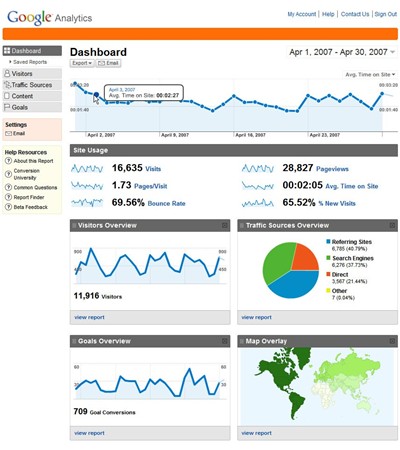
Google is set to take on several paid for Internet measurement Companies in Australian with version 2 of its highly popular web measurement software Google Analytics.

As a debate rages over Internet measurement Google has rolled out a new version of its free web measurement service Google Analytics. The new version was announced today at the EMetrics Summit in San Francisco.

In Australia it is competing head on with paid web measurement companies like Nielsen Net Rating which was recently critisised when it suggested that the bulk of visitors to Australian IT sites were from overseas. Also competing with Google is Facilitate Digital which markets the Silhouette web measurement software. 

Google Analytics allows executives, marketers and Web site owners to examine how their users interact with their Web site and help increase online business. The company has done a total redesign on the product and improved the feature set through new email reporting, customizable dashboards, map displays, and plain language descriptions to make information easier to access.


Click to enlarge

“At Geffen Records, we use Google Analytics to determine what website content is most valuable to music fans so we can craft the most effective marketing strategies,” said Aaron Foreman, Head of Digital Media, Geffen Records.

“As an early adopter of the new version of Google Analytics, we are impressed with the richness of the data and its ease of use that provides us with the most important information immediately,” said Lee Hammond, Director of Digital Technology, Geffen Records.

In the new version of Google Analytics, data is organized into combinations of reports, so users can make decisions about site management and Google AdWords campaigns. Google Analytics tracks online marketing campaigns and generates email reports that can be shared with co-workers.


Beginning today new users will have access to the updated version. Current users will be able to access the old version and the new version for 30 days and all historical data will be available in the new version.

“At Google, we’re focused on building powerful tools to help advertisers measure the effectiveness of their marketing dollars and optimize their business,” said Paul Muret, Engineering Director, Google.

“The new version of Google Analytics will give advertisers and site owners greater insight into their customers’ needs, thereby increasing advertiser ROI while also improving the e-commerce experience of consumers.”


Hi Fi Gear Takes Off In Cars

Australians have always been in love with their cars and music. Now they want a new level of music gear in their cars along with navigation gear and iPods. In the luxury car market brands likke Jag, Lexus, BMW and Audi are lining up with some of the biggest Hi Fi brands in the world in an effort to meet the demands of their clients.

Mark Levinson and Bowers & Wilkins (B&W) are each now combining passions with their respective partners, Lexus and Jaguar to provide auto aficionados and music enthusiasts the ultimate top down, wind in the hair, music blasting driving experience.

In a trend that further intensifies the relationship between the consumer electronics and automotive industries, B&W has joined Levinson in the ranks of high-performance audio companies that are partnering with luxury auto manufacturers.

A New Twist on a Growing Phenomenon

The alliances between audio and auto companies are nothing new. In fact Bose, JBL, Infinity and Boston Acoustics have enjoyed prosperous alliances with the car industry for a long time.

Audi showcased its optional B & O audio system for the S8 at the Melbourne Motor Show.


The (rather unimaginatively titled) Advanced Sound System was developed by Bang & Olufsen features a powerful digital signal processor, discrete amplification (to the tune of 1000 watts RMS) for all of the 14 loudspeakers and acoustic lenses.

You’d want it to for 15 grand. Mind you, you do get hand-polished and engraved grilles, which are machined from solid aluminium and colour match the leather seats.

The Acoustic Lens Technology is claimed to provide a wide horizontal sound dispersion of high frequencies. The acoustic lenses automatically rise out of the dashboard when the sound system is engaged and are said to ensure an extremely detailed acoustic stage from any seat in the car.


In 1998, the arms race for the ultimate car audio system received a significant boost in competitiveness when the revered audio brand Mark Levinson agreed to an alliance with Lexus after the popular carmaker decided it needed to improve the performance of its audio systems.

“In the late 1990s Lexus looked to upgrade its audio offerings, and it began investigating the leading global audio brands,” notes Walter Schofield, vice president of sales and marketing for Mark Levinson. “Recognizing the existing relationship between Toyota Motors [Lexus is a division of Toyota ] and Harman International [Mark Levinson is a division of Harman Specialty Group], Lexus approached Mark Levinson with the concept of a partnership.”

Initially, Schofield explains, Levinson’s engineers were apprehensive about trying to create an audiophile experience in an auto environment, but after extensive testing the company found that Lexus’ interiors were 3dB quieter than its competition, and this fact allowed Levinson to meet the challenge of engineering a state-of-the-art car audio system.


The British Invasion

At CES, it’s not a surprise when B&W launches a new loudspeaker or subwoofer, but its announcement of its newly signed alliance with Jaguar likely caught even the most informed audio industry analysts of guard.

Martin Lindsay, senior business development manager, automotive entertainment for the B&W Group Ltd., says the parties involved have been quietly working on this arrangement for a couple of years. “We started our collaboration with Alpine almost two years ago. It started with a B&W driver specification and prototype production runs. As usual, we used extensive listening tests and acoustic measurements to fine-tune things like the Kevlar cone composition while ensuring that all the parts passed the stringent automotive tests,” Lindsay says.

“About a year ago, we began tuning the sound of the complete system in the car with the assistance of Alpine and Jaguar to help us calibrate the speed-dependant EQ. Final sign-off was completed in the fall of 2006, using reference-selected mean drivers in the first production vehicle available.”


Alliances Benefit Dealers

Levinson’s alliance with Lexus has been in place for nearly a decade and during this time, Schofield says, both brands have joined forces on numerous occasions to expose Lexus buyers to the Mark Levinson product line, including Lexus customer events and a recent Paul McCartney tour that featured a VIP lounge, which utilized a Mark Levinson home system.

“Mark Levinson provides substantial multimedia presentation support,” he points out. “Local Mark Levinson dealers are involved and they help make these events a success for Lexus.”

B&W foresees a similar concept for its global dealer base. Lindsay says that one of the major benefits for B&W and its dealers is that the alliance exposes the brand to a larger demographic of affluent consumers.

“It will help us in communicating to a bigger audience; both Jaguar and Bower & Wilkins will introduce this audience to the virtues of a better sound experience,” says Lindsay.

He adds that B&W has already worked with Jaguar on a tour that visited six cities in trhe US and highlighted the technologies of the C-XF concept vehicle. The concept is expected to go global.

Notebooks To Be 40% Of 12% Growth In PC Sales In 2008

PC shipments are set to rise close to 12% with notebooks making a major contribution to the growth spurt. During the next 12 months notebooks will account for over 40% of sales.

Top executives from Dell, Panasonic, Philips and Sony have agreed that the Apple iPhone is the most important introduction in consumer electronics of the past 20 years.

The comments were made during the Manufacturer Power Panel at the CEA CEO Summit, being held in the USA.

Ron Garriques, president/CEO of Dell Global Consumer Group, Stan Glasgow, president/COO of Sony Electronics, Stewart Muller, president/CEO of Philips Consumer Electronics, and Joseph Taylor, a Vice President at  Panasonic were members of the panel, which was moderated by Gary Shapiro, president/CEO of the Consumer Electronics Association (CEA), which hosts the annual Summit.

With the planned debut of Apple’s iPhone, Shapiro asked the four executives their opinions of the introduction and if it is, as some have claimed, the most important introduction in CE of the past 20 years.

Garriques said, “If you can reset in the consumers’ minds that cellphones can be priced at $499 to $699, instead of the thinking that it is just $1, that’s good.” He echoed the view of his colleagues that “the marketing and hype surrounding iPhone is good,” and said that even if iPhone isn’t all that it is supposed to be “you know that they are working on iPhone2, iPhone3 and 4 versions.”


Taylor said, “Apple makes intuitive products. You can open the box and figure them out in two minutes. We can learn from Apple and make things easier to use.”

The subject of design trends in the industry was discussed and all agreed with the fact that consumers want a more personalized experience when it comes to using CE products and get away from commodity products.

Glasgow said that Sony “looks to consumer input” to “personalize a lot of products, not just in the United States but around the world. We try to create personal values” in products “with consumer input.”

Taylor volunteered, “We can create content to distribute to our friends, family and around the world … with HD camcorders, digital cameras and cellphones. User-generated content is having a profound effect on society. ‘You’ were named Time magazine’s Person of the Year. How all this will affect manufacturers is yet to be determined.”


Retailing is never far from these executives’ thoughts and Garriques discussed changes at retail and PC technology at the same time. He reminded everyone that Dell “has a 99 percent direct model” and that for a long while the PC business was just about ” ‘speeds and feeds’ with better processors, better software.” Five years from now he wants Dell to be “a broad retail player giving the traditional type of devices on value” and provide what he calls “needs and deeds” to leverage up the technology to provide a richer consumer experience.

On the subject of retail in five years, Garriques said that Dell’s recent deal with Wal-Mart may be the first in other types of retail distribution deals with “other retailers that provide more specified solutions that can add more content and value.” About the current struggle of today’s retailers, he was blunt. “The problem is there are just too many retailers now. I would see that settle down in five years.”

In discussing retail, Muller said manufacturers “Have the responsibility to give the tools to retailers to succeed.” That being said he noted that even with such support, poorly performing retailers would still go out of business.

Muller noted that “retail partnerships” is an overused term, but that suppliers “should not come up with new partners every six months” and that retailers shouldn’t drop brands over the short term “just based on price … we need true partnerships.”


Glasgow reiterated what he said at his recent Sony Roundtable about the current state of retailing when he noted, “Volume players deliver good value, but when a medium retailer goes national, they can have problems.” He added that those specialty retailers or regional players that provide strong customer service can thrive.

When asked by Shapiro if today’s CE products are too complex, Taylor said, “Consumers have had no problems opening up a TV, radio or DVD and operating it. The story goes downhill from there. Consumers say they want all these features, but then the take them home and realize they don’t need them all or feel they are too complicated.”

Muller brought up the point that with Philips, and for that matter the other companies on the panel being global suppliers, “The level of expectation in many Countries for ease of use is much higher here than the rest of the world. In the U.S. we are technologically lazy. In Japan, in Europe consumers tear through instructions, but here, we want the product to jump out of the box and work. We can’t change the U.S. consumer and have to deal with that.”


And when Shapiro asked if the industry has done enough, or should do more, to educate consumers about the analog TV shutoff in February 2009, Glasgow jumped in saying, “We feel as an industry we need to educate consumers more, to work with CEA because consumers [in 2009] will be disappointed. Half of those who buy HDTVs today don’t get an HD [content] source. It’s better because it was 70 percent [in the past two years]. We are very concerned about this and we need to do more.”

Muller added, “The transition is tough. About 12 percent of consumers could be disenfranchised. Maybe with all this noise about the transition, the fact people realize now that digital TV is not HDTV, will help. More HDTV programming and the marketing of it will help awareness on the issue get better, but the 12 percent or so who rely on over the air signals are a challenge.”

 

Apple iPhone The Most Important Product In 20 Years Claims Industry Heavies

Several of the world’s leading CE executives have said that the pending launch of the Apple iPhone was most important introduction in CE of the past 20 years. They also claimed that consumers want a more personalised experience when it comes to using CE products and the industry needs to get away from commodity products. The comments were made during a major industry Summit in the US over the weekend.

Top executives from Dell, Panasonic, Philips and Sony voiced their opinions and agreed on many of the issues facing their companies and the industry during the Manufacturer Power Panel at the CEA CEO Summit, being held in the USA.

Ron Garriques, president/CEO of Dell Global Consumer Group, Stan Glasgow, president/COO of Sony Electronics, Stewart Muller, president/CEO of Philips Consumer Electronics and Joseph Taylor, executive VP/COO at Panasonic were members of the panel, which was moderated by Gary Shapiro, president/CEO of the Consumer Electronics Association (CEA), which hosts the annual Summit.

The subject of design trends in the industry was discussed and all agreed with the fact that Glasgow said that Sony “looks to consumer input” to “personalise a lot of products, not just in the United States but around the world. We try to create personal values” in products “with consumer input.”


Taylor volunteered, “We can create content to distribute to our friends, family and around the world … with HD camcorders, digital cameras and mobile phones. User-generated content is having a profound effect on society. ‘You’ were named Time magazine’s Person of the Year. How all this will affect manufacturers is yet to be determined.”

Retailing is never far from these executives’ thoughts and Garriques discussed changes at retail and PC technology at the same time. He reminded everyone that Dell “has a 99 percent direct model” and that for a long while the PC business was just about ” ‘speeds and feeds’ with better processors, better software.” Five years from now he wants Dell to be “a broad retail player giving the traditional type of devices on value” and provide what he calls “needs and deeds” to leverage up the technology to provide a richer consumer experience.

On the subject of retail in five years, Garriques said that Dell’s recent deal with Wal-Mart may be the first in other types of retail distribution deals with “other retailers that provide more specified solutions that can add more content and value.” About the current struggle of today’s retailers, he was blunt. “The problem is there are just too many retailers now. I would see that settle down in five years.”


In discussing retail, Muller said manufacturers “Have the responsibility to give the tools to retailers to succeed.” That being said he noted that even with such support, poorly performing retailers would still go out of business.

Muller noted that “retail partnerships” is an overused term, but that suppliers “should not come up with new partners every six months” and that retailers shouldn’t drop brands over the short term “just based on price … we need true partnerships.”

Glasgow reiterated what he said at his recent Sony Roundtable about the current state of retailing when he noted, “Volume players deliver good value, but when a medium retailer goes national, they can have problems.” He added that those specialty retailers or regional players that provide strong customer service can thrive.

With the planned debut of Apple’s iPhone, Shapiro asked the four executives their opinions of the introduction and if it is, as some have claimed, the most important introduction in CE of the past 20 years.

Garriques said, “If you can reset in the consumers’ minds that cellphones can be priced at $499 to $699, instead of the thinking that it is just $1, that’s good.” He echoed the view of his colleagues that “the marketing and hype surrounding iPhone is good,” and said that even if iPhone isn’t all that it is supposed to be “you know that they are working on iPhone2, iPhone3 and 4 versions.”


Taylor said, “Apple makes intuitive products. You can open the box and figure them out in two minutes. We can learn from Apple and make things easier to use.”
 
When asked by Shapiro if today’s CE products are too complex, Taylor said, “Consumers have had no problems opening up a TV, radio or DVD and operating it. The story goes downhill from there. Consumers say they want all these features, but then the take them home and realize they don’t need them all or feel they are too complicated.”

Muller brought up the point that with Philips, and for that matter the other companies on the panel being global suppliers, “The level of expectation for ease of use is much higher in some Countries than the rest of the world. In the U.S. we are technologically lazy. In Japan, in Europe consumers tear through instructions, but here, we want the product to jump out of the box and work. We can’t change the consumer and have to deal with that.”


When  Shapiro asked if the industry has done enough, or should do more, to educate consumers about the analog TV shutoff in February 2009, in the USA and 2010 in Australia, Glasgow jumped in saying, “We feel as an industry we need to educate consumers more, to work with CEA because consumers [in 2009] will be disappointed. Half of those who buy HDTVs today don’t get an HD [content] source. It’s better because it was 70 percent [in the past two years]. We are very concerned about this and we need to do more.”

Muller added, “The transition is tough. About 12 percent of consumers could be disenfranchised. Maybe with all this noise about the transition, the fact people realize now that digital TV is not HDTV, will help. More HDTV programming and the marketing of it will help awareness on the issue get better, but the 12 percent or so who rely on over the air signals are a challenge.”

Linksys Roll Out Low Cost Mature VoIP Offering

The VoIP market is set to hot up with the launch by Linksys of a low cost VoIP solution that is as ideal for the Smart Office as it is the SmartHouse.

Small-medium businesses in Australia would save thousands of dollars by moving to an IP based phone system such as the recently launched System One solution from Linksys a division of networking giant Cisco.

Rod Brown a Brisbane based IP systems engineer said at the launch of the new IP based phone system that a Queensland based business who had implemented a Linksys VoIP system had managed to cut their normal phone costs from $1600 a month to $400 a month and had in fact recovered the cost of the deployment within 3 months.  

Based on a new generation of networking and IP phone technology the new system appears to very inexpensive with video handsets ranging from $350-$400 and the backend switch gear costing less than $900.

Linksys unwrapped the 2.0 version of the software that runs its Linksys One hosted voice over IP solution at a press event in Sydney. The new IP based solution adds PBX features tailored to the needs of small businesses. They also announced a revamped Cisco service node that powers the Linksys One solution, and several new switches and routers for remote and branch offices.

Linksys One all-in-one service routers, IP phones and VoIP gateways are the cornerstone of Linksys’ small business strategy. Version 2.0 gives Linksys One the ability to support up to 100 users and to link up to five different sites using VPN connections for voice and data, said Graeme Reardon, Regional Director at Linksys Asia Pacific.

Another feature called single number reach gives small business customers the ability to ‘move’ calls between Linksys One and their cell phone, he added.


Reardon claims that Linksys One is a purpose built hosted solution that helps Service Providers to deliver a comprehensive, easy-to-use and easy-to deploy solution for the small business market. Linksys One small business system can help integrate data networking, security, configuration back-up, and low-cost Voice-over-IP (VoIP) services with applications and other business services into one simple solution. It can be customized to each company’s specific requirements and can grow as a business grows with additional Linksys One Ready Switches and Network Storage Systems, Linksys One VoIP Phones, and other devices that instantly connect to and automatically install on the network.

Linksys One takes the burden of communications technology away, leaving growing businesses to focus on their business. Small businesses enjoy all the competitive advantages of a business-quality IP network that can grow as their business does.

The Linksys One solution is available from Hosted Solution Providers (HSPs) such as Sydney based IP systems that provide Internet connectivity, IP voice services and other applications over a broadband connection, an in conjunction with authorised Value Added Resellers such as Soul (VARs) who provide and install the Linksys One data networking or VoIP phone equipment directly on-site. Additionally, HSPs and VARs have the ability to remotely manage some or all of the Linksys One devices on the small business customer’s network, enabling those customers to focus their time and resources on their core business.

Former Global Microsoft Exec Gets Top Gig At Telstra

The former worldwide head of marketing at Microsoft, Vivianne Arnold, has been appointed to the role of General Manager of Marketing at Telstra. The move comes as Telstra restructures its marketing department signalling greater integration across all marketing activities.

Telstra created the new position of general manager of brand integration and appointed Microsoft worldwide marketing director Vivianne Arnold to the role.

Arnold oversees Telstra’s brand strategy ensuring integration of all marketing disciplines. Arnold’s brief includes personalised marketing, digital marketing and the Telstra Shop’s IPTV network.

She also heads a new Telstra marketing think-tank called the Innovation Lab. A Telstra statement said Arnold brings “a valuable balance of strategic vision and practical implementation that will help us deliver sustainable business results”.

Arnold joined Telstra on 29 March from her role as Microsoft’s worldwide director for its worldwide business & marketing organisation in Paris.

Before taking up that position she was senior global marketing manager at Microsoft’s headquarters in Seattle. Arnold joined Microsoft in 1999 from her role as integrated account director at George Patterson Bates.