
Smart Office

BMW Technology And Art Worth Millions Coming Back To OZ

The now famous BMW Art Car Collection is coming back to Australia for the first time in 18 years. The collection which had its world premiere at the Powerhouse Museum in Sydney in 1989 includes a car painted by Andy Warhol. It has been described as priceless.

They may not be the latest in technology on the surface, but the BMW Art Car Collection, which is due back in Australia in June, is definitely packed with technology under the bonnet.  In fact some of the technology such as multi valve engines and BMW braking systems first appeared in the cars painted by the BMW Art Car artists. 

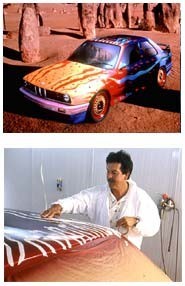
Ken Done paints his Art Car

The collection which had its world premiere at the Powerhouse Museum in Sydney in 1989 is due back in Australia in June 07 at the Museum of Contemporary Art in Sydney. Among the rare BMWs coming back to Australia are Art Cars painted by Andy Warhol, Roy Lichtenstein and Frank Stella.

Michael Jagamara Nelson Paints his BMW Art Car


Between 1989 and now, millions of people have seen the collection around the world at locations like the Museum of Modern Art in New York.  Under the bonnet of each Art Car is a BMW motor car than has won a World Championship, Le Mans or a European Touring car championship. In 1989, Australians Ken Done and Michael Jagamara Nelson were commissioned to paint a BMW Art Car. As a creator of one of these unique pieces, they joined an elite group of global artists, which includes Andy Warhol, Roy Lichtenstein, Frank Stella and Robert Rauschenberg.


 The Art Car concept began in1976, when Alexander Calder was commissioned to embellish the BMW of his friend, French racing driver Herve Poulain.  However the project stalled and the cars were warehoused at the BMW 5series plant in Germany until they were resurrected and bought to Australia.

 As the project manager for the BMW Art Car Collection I worked closely with both Ken Done and Aboriginal artist Michael Jagamara Nelson.


When commissioned, Ken Done, made his racing car as optimistic and colourful as his pictures. The style he chose was intended on one hand to express the fascinating appeal of the M3 as a fast and dynamic automobile, while on the other hand it had to be typically Australian.

This is why Done intentionally chose an abstract rendition of parrots and parrot fish: ‘Both are beautiful and move at fantastic speed. I wanted my Art Car to convey the same impression.” He said at the time.

The Art Car Collection was not without its dramas. In an effort to test the baking capability of Aboriginal Art in an automotive oven used to bake the paint dry on a motor car, a BMW 3 series door was shipped to Michael Jagamara Nelson in the Northern Territory outback. When the door was returned it was baked and taken to the Powerhouse Museum. Mysteriously the door which overnight was suddenly worth tens of thousands of dollars, disappeared only to turn up months later in the office of the then director of the Powerhouse Museum.  It was later donated to the Powerhouse Museum by BMW Australia.

Online Retailing Could Be 8% Of Sales This Year

Online retailing is set to account for between 7 and 8 percent of all retail sales in Australia, up from 2-3 percent currently, says accounting firm Ferrier Hodgson.

James Stewart, a partner at the accounting company, said the British and US retail markets had already reached the 7-8 per cent threshold, and Australia was likely to catch up. “We have a slightly different issue in terms of density of population,” Mr Stewart told the ABC TV’s Inside Business program.

“Our freight costs are proportionately higher for a lot of retailers, whereas in the UK and US market they can spread those freight costs across a more dense population base.

“But I think we’ll get there; we’re early adopters of technology, we’re early adopters of internet activities and things like that, and that’s where we’ll go.”

Mr Stewart said the tough retail environment was partly explained by a growing shift to online shopping, which reduced spending in stores.

Overseas web sites could end up being 5 percent of total sales claims a CitiGroup analyst.

Retail giants, including Harvey Norman and Myer, Target and David Jones, are currently lobbying the federal government to close a loophole that allows online shoppers to buy overseas merchandise free of tax, provided it costs less than $1000.

The companies have argued it is unfair that they have to pay GST and import duties of up to 20 per cent when foreign retailers are exempt.


But I think there are greater factors at play — there’s no doubt there’s the GFC impact,” he said.

“Economically, people are feeling very different. When you see interest rates go up, when you see the cost of living going up, that affects your bread and milk money.

“And then compare it to online; people are starting to research more about what they’re going to buy, particularly when it comes to discretionary items.”

Most retailers had a “pretty tough” Christmas, with a lot going on sale early in the season. This had left them with “nowhere to go” in the traditional January sale period.

Microsoft To Offer Free Vista Upgrade

Microsoft has teamed up with PC vendors to promote the delayed Vista OS by offering PC buyers worldwide a free upgrade coupon, as a way of encouraging them to buy a Vista-capable PC as early as possible, according to market sources, citing information leaked from Taiwan-based PC makers.

With the coupon offer to kick off in October, prospective buyers who have planned to purchase a Vista-enabled PC in the first quarter of 2007 when the new OS is launched, will be encouraged to take up a Vista-capable PC in advance, the sources asserted.

Ray Chen, president of Compal Electronics, confirmed the coupon offer at a company investor conference held yesterday, stating that the free upgrade coupon, together with the availability of Intel’s 64-bit-enabled Merom processors, will help boost demand for new PCs in the fourth quarter of this year as well as in the first quarter of 2007.

Microsoft actually reached such an agreement with PC vendors in July, but decided not to unveil the plan until the fourth quarter, so as not to affect PC sales in the third quarter, the source noted.

The leak of the coupon-offering plan indicates that Microsoft may launch the Vista OS in January 2007, in line with its revised schedule, the sources said. However, PC sales worldwide now might now be affected by the plan, they cautioned.

EMC Buys Interlink

EMC has acquired the Interlink Group which consults on integrating Microsoft software applications.

EMC has acquired the Interlink Group which consults on integrating Microsoft software applications.

The companies did not initially reveal transaction terms. Interlink had $21.5 million in revenue in 2004, according to VARBusiness Magazine. EMC sells information storage and management systems. It was the company’s second acquisition this week, following a $153 million deal to purchase California data-replication software firm Kashya Inc.

Interlink was founded in 1989 and is based in Englewood, Colo. The firm adds 180 people to EMC’s professional-services workforce, which numbers more than 9,000 people.  In January, EMC acquired Internosis of Greenbelt, Md, which similarly consults on Microsoft platforms. EMC recently expanded an alliance with Microsoft.

EMC had 26,500 employees at the close of 2005, but has laid off 500 employees in the past two quarters and plans that many more job reductions before year end. EMC indicates it expects to exit 2006 with a higher head count from acquisitions and hiring in other areas.

6 Gigabits A Second Over Wireless Achieved

Communications Minister Helen Coonan has hailed a CSIRO wireless communications link claimed to be capable of transmitting data at a world-record six gigabits per second over a very short, point-to-point wireless connection as “great news for the future of broadband in Australia”.

The system is “suitable for situations where a high-speed link is needed but it is too expensive or logistically difficult to lay fibre, such as in congested urban environments, and across valleys and rivers,” she said.

 Dr Jay Guo (pictured) director of the Wireless Technologies Laboratory at CSIRO, said the demonstration held late last week was just a first stage towards direct connections of up to 12Gbps.

 However, he is more modest about its applications. “The system is ideal for creating networks to meet short-term needs such as emergencies and large events,” Guo said.

 In Friday’s demo, the team transmitted 16 simultaneous streams of DVD quality video over a 250-metre link with no loss of quality or delays. This used only a quarter of the capacity available, the organisation claimed.

 Apart from speed, the CSIRO says the link achieves the highest efficiency

(2.4bits/s/Hz) ever for such a system.

 The team of 20 researchers came from a number of disciplines, said CSIRO CEO Geoff Garrett. The system operates at 85GHz in the millimetre band of the electromagnetic spectrum which is not yet congested by other uses.

Licence Fee To Watch TV On A PC

Britons have been told they must pay a TV licence fee if they want to watch BBC Internet broadcasts on a PC – or risk a stiff fine.

TVL, the UK’s television-licensing authority, issued the warning last week on the eve of the World Cup soccer finals in Germany, which the BBC is broadcasting live online as well as on TV

 Furious Net surfers claimed TVL was out of line, since no TV set was involved in picking up a pure Internet feed, and no licence should be required.

But TVL told one Web site that the definition of a “television receiver” in the Communications (Television Licensing) Regulations 2004 covers any apparatus used for the purpose of receiving – by wireless telegraphy or otherwise – any TV program service.

The authority said this means that the TV-licensing regulations cover Internet broadcasts on PCs, PDAs and mobile phones.

New Microsoft Phone OS

Microsoft has realeased a beta verion of its new embedded CE 6 Mobile Phone OS.

Windows CE 6 beta boasts a redesigned OS kernel architecture, expanded capacity for simultaneous processes and a new integrated tool set. Microsoft said these features would help device makers more quickly create devices, such as IP set-top boxes and GPS-based mobile phones and PDAs, which support more applications for high-demand categories.

Windows CE 6 also has a plug-in for Visual Studio 2005, which gives developers a single tool to develop both operating systems and applications, Microsoft said.

“With Windows CE 6, not only do we now have a single unified tool that allows us to develop software for embedded operating systems and applications, we have a more powerful and flexible kernel that serves as a platform for next-generation device requirements,” said Chris Tacke, principal partner at OpenNETCF Consulting LLC, who doubles as a Windows Embedded ‘Most Valuable Professional.’

“These two features alone allow developers to build and debug the entire device solution quickly and easily, and all without having to learn two tool sets,” he said, in a statement.

The new OS kernel architecture supports significantly more simultaneously running processors, from 32 up to 32,000, each of which runs in a 2GB virtual memory address space, Microsoft said. This allows developers to incorporate larger numbers of more complex applications into more devices that offer advanced multimedia and Web services and wireless networking.

And Windows CE 6 is backward compatible with older versions. It also builds on Microsoft’s Shared Source Initiative, which gives devs access to “millions of lines” of CE source code, said the company. Devs and device makers can modify and distribute custom components within their CE-based products.

Intel Corp said it would continue to work with Microsoft to boost the performance of CE- and Intel XScale-based technology. “We continue that collaboration with Intel’s third-generation Intel XScale technology-based processor family, code- named ‘Monahans,’ and Windows CE 6,” said Barry Evans, general manager of Intel’s applications processor business unit.

Linksys Founders Quit

Victor and Janie Tsao the founders of Linksys are set to quit the consumer and SMB networking outfit to take on new roles at Cisco Linksys’ parent company.

Victor and Janie Tsao the founders of Linksys are set to quit the consumer and SMB networking outfit to take on new roles at Cisco Linksys’ parent company.

Cisco plans to disclose that the husband-and-wife team is leaving its Linksys division to work in its China business. Victor Tsao had been serving as senior vice president and general manager of Linksys, while Janie Tsao was senior vice president of sales, marketing and business development.

Michael Pocock has taken over as senior vice president and general manager, effective May 8, according to a company statement. He reports to Charlie Giancarlo, senior vice president and chief development officer of Cisco and president of Cisco-Linksys.

The Tsaos co-founded Irvine, Calif.-based Linksys in 1998. It was acquired by Cisco in June, 2003 in a stock dea

l valued at $500 million.

The move comes as Linksys is working to bulk up its SMB offerings in an effort attract more business customers and solution providers with its networking, wireless and IP telephony wares.

Last year Linksys launched Linksys One, a new SMB-focused division that targets the hosted VoIP market.

In his new role, Pocock will oversee worldwide operations, sales, marketing, human resources, training, customer advocacy and all product development and engineering for Linksys, according to the statement.

Pocock is probably best known to the channel through his tenure at Compaq Computer, where he served as North American channel chief and later headed up Compaq’s worldwide commercial PC business. He most recently served as president and CEO of Polaroid, which he joined in 2003.

Victor and Janie Tsao will continue to report to Giancarlo. They are tasked with seeking out business investment opportunities in the Chinese market for Cisco and Linksys. Their new titles were not disclosed.

“We felt the organisation was ready for a new leader who would take Linksys to its next level,” said Janie Tsao in the statement. “We have more than doubled our revenue since we were acquired in 2003 and we think the organization will benefit from someone with more experience in managing multi-billon dollar corporations.”

Cisco President and CEO John Chambers has identified Chinese networking vendors as a growing challenge to Cisco’s business.

The Tsaos plan to stay on at Linksys “until Pocock’s transition is complete.” After that, they will to serve as consultants to Linksys, the company said.

Pioneer Launches BluRay Burner

Pioneer Electronics has begun shipping what it calls “the first commercially available” aftermarket PC Blu-ray Disc recorder (BD-R) on the U.S. market.

The BDR-101A drive will be bundled with Sonic Solutions’ Roxio Blu-ray Disc software and a blank TDK 25GB write-once (BD-R) disc with a US$999 suggested retail. It is expected that Pioneer will launch the product in Australia

 “As we move deeper into the transition to high-definition content creation and distribution, increasing storage capacity will become more and more critical,” said Andy Parsons, Pioneer senior VP. “Blu-ray Disc technology fulfills the rapidly growing need for additional storage space, and Pioneer is proud to be one of the first companies bringing it to market through the BDR-101A.”

This first-generation drive is targeted toward professional users and early adopters who will be using Blu-ray for advanced storage needs.

The Roxio software bundle will support high-definition BD authoring applications by transferring BD images to BD-R and rewriteable BD-RE media.

The TDK media, which shipped last month, retails for $19.99 a disc.

Earlier this week Sony introduced a high-end Vaio notebook sporting a Blu-ray burner.