Smart Office

Expedia Takes Travel Booking To Mobile Phones

Expedia.com who has upset Australian travel retailers because they don’t charge fees like Australian operators, is launching a free app allowing travelers to book hotel rooms from their Phone and iPod touch mobile devices.

Expedia Hotels uses GPS to find available hotels, within walking distance of the traveler. Expedia Hotels is the first app introduced by Expedia since the company acquired mobile travel apps company Mobiata in November.

The phone initative, is the first in a series of mobile services that the company will roll out in 2011. Bellevue-based Expedia already offers mobile booking of flights, cars, and activities.

The Expedia Hotels app should be available in a few weeks from the Apple App Store.

Local operators got upset earlier this month by launching a multi-million-dollar advertising campaign attacking them for “extortionate” fees it says are annoying consumers.

Expedia axed online booking fees about 18 months ago and is using the campaign, including 30-second television spots, to highlight charges levied by its online and “bricks and mortar” competitors.

It says research commissioned last year found that website fees angered consumers and that three-quarters of 1100 Australian and New Zealanders surveyed said they should not be charged.

JB Hi Fi Charman Talks About Their Youth Brand, Parallel Importing & Selling Appliances Online

EXCLUSIVE: As Harvey Norman moves online, JB Hi-Fi has moved to restructure their operations for what their Chairman describes will be a “record year”. He also said that the future is “low cost” retailing and that parallel importing is a “temporary issue”.

In an exclusive interview with ChannelNews JB Hi-Fi Chairman Patrick Elliott said that JB Hi Fi was Australia’s most recognised “youth brand” and that the group is still on track to open between 13 and 15 new stores, some of which will be converted Clive Anthony stores.

He said that the youth of today, who are shopping at JB HI Fi will be their customers in the future, if they “do the right thing by them. The opportunity we have to leverage that youth brand into online is significant. This is an audience that is used to online trading and recognise brand values”.

Speaking about retailers who have an older target audience Elliott said: “These retailers will reach a point where they are going to have to renew their customer set”.

He claimed that Internet trading is set to be an issue for many retailers in the future and that parallel importing is a “temporary issue” that will go away as the market re-adjusts to lower prices.

“Local manufacturers realise that they are losing control of global supply. As a result they are already starting to lower their costs in Australia in an effort to stay competitive” Elliott said.

“It will get to the stage where bringing in small shipments of goods from overseas will not be cost effective and due to the lowering of prices in Australia driven by online the market will rebalance itself” he said.

Last week, JB Hi Fi alerted the market to the restructure of their struggling Clive Anthony brand, with Elliott admitting, during a recent interview on the ABC program Inside Business, that some stores will be closed. He described Clive Anthony as an experiment “that hasn’t succeeded in its current format”.


One of the options now being considered by JB Hi Fi is to launch an online appliance store, a move which Elliott admits will appeal to a lot of consumers due to the high replacement factor that appliances attract.

“Going online makes a lot of sense. We want to be a low cost retailer. We are competing against retailers who have expensive property structures such as department stores. If department stores want to carry on selling appliance they are going to have to deliver exceptional in store service to keep attracting customers. The future is low cost which is where JB Hi Fi is operating”.

Elliott said that net profit at JB Hi Fi for the 12 months to June was now likely to be $108.5 million to $113.5 million, compared with the previous forecast of between $134 million and $139 million.

“I think there are plenty of good days still to come, we have an excellent management team at JB Hi Fi, and they love their jobs and are well rewarded for it. I think our model is right,” he said.

Elliott also said that closing down its underperforming discount electrical retailing brand, Clive Anthony’s was “one of the options” that the group was considering.

“The expectation is that we’ll be able to convert quite a few of those stores to JB Hi-Fi stores,” Mr Elliott said during his ABC interview.

“We’re looking at perhaps a change to the format for those stores, but remaining in appliance retailing, although it may be on a somewhat smaller scale, and some of those locations which aren’t profitable we will look to close.”

“The internet model is particularly well suited to do that, whereas the bricks and mortar model is less so, so this discussion is very much more around where we are with currency, perhaps, than any significant change in technology or the uptake in technology.”


Elliott said JB Hi-Fi’s online business was growing, but stressed that its “bricks and mortar” model was “very low-cost”.

“Our cost of doing business, which is everything below the gross margin line, is about 14, 14.5 per cent of sales,” Elliott said. “There wouldn’t be too many online retailers who have that low cost base, and so we’re comfortable that with our scale, our buying power and our low cost to business that we can compete quite effectively with an online retailer, and to that extent clearly pushing our own online model.”

Suppliers of software and possibly cameras would also adjust their domestic prices to match international prices thanks to the “lag effect” of the rising dollar, Elliott said.

ATO Court Win May Force Rethink For OZ CE &N IT Companies

As the ATO starts to probe transfer pricing in Australia, in particular the price those local subsidiaries of large consumer electronics and IT companies, pay for goods from their parent Company, a Federal Court judge has ruled as to how a local subsidiary should be taxed.

As the ATO starts to probe transfer pricing in Australia, in particular the price those local subsidiaries of large consumer electronics and IT companies, pay for goods from their parent Company, a Federal Court judge has ruled as to how a local subsidiary should be taxed.

In a major decision that may have ramifications for a number of Australian technologies Companies IBM Australia has lost a $55 million Federal Court case about how revenue paid to it by its Australian subsidiary should be taxed. The company is expected to appeal.

The US-based IBM Corporation, IBM World Trade Corporation and local subsidiary IBM Australia in July 2009 filed a lawsuit against the Australian Commissioner of Taxation over claims that it owed amounts of $26 million and $29 million on earnings from the Australian subsidiary in 2004 and 2005.

Under a 1987 software licensing agreement, IBM Australia paid 40 percent of its revenues to the US parent in exchange for the right to “use, distribute and market” software created in the US.

The company claimed a portion of these payments should not classified as revenue or royalties on which withholding tax would have to be paid.

However, Justice Annabelle Claire Bennett yesterday dismissed IBM’s claims, ruling that Big Blue was liable to pay withholding tax on the full amount. She also ordered that IBM pay the ATO’s legal costs.

A spokesman for IBM Australia said that company was reviewing its position. But the spokesman said: “Whilst IBM Corporation is disappointed with the court’s decision; it has fully complied with relevant tax laws, met all of its tax obligations, and will continue to do so”.

Senator Xenophon Accused Of Telling Big Fat Lie

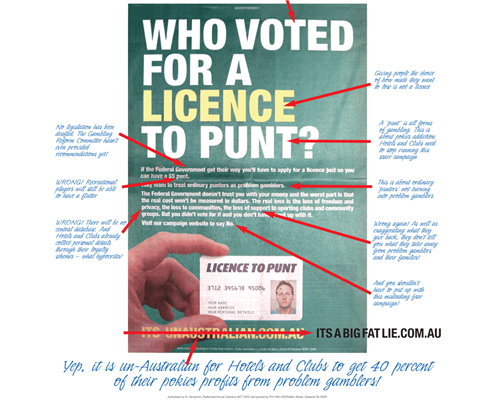
Independent Senator Nick Xenophon has been accused of “tellling a big fat lie” on a new web site that he has rolled out in an effort to combat a $20M campaign by Clubs Australia.

Earlier today Xenophon complained  to the Australian Competition and Consumer Commission (ACCC), about a gambling advertising campaign by Clubs Australia and the Australian Hotels Association.


Click to enlarge

The Clubs campaign states that Federal Government’s proposed changes affecting gambling would mean people would need to apply for a licence to make a $5 bet.

Senator Xenophon says the statement and a number of others in the campaign are incorrect and misleading.

However Clubs Australia claims that it is Xenephon who is misleading consumers by claiming on his new web site that it is “Un Australian for Hotels & Clubs to get 40% of their pokies profits from problem gamblers”.

A Clubs Australia spoksperson said “If Xenephon is claiming that 40% of Club profits come from problem gamblers he is wrong. Club profits come from all gamblers as well as entertainment services food and catering”.

Senator Xenophon was not available to comment.

$153bn Apple Brand Pushes Out Google To Take Top Brand Slot

Apple, whose brand is now worth over $150bn, has pushed out Google to become the world’s most valuable brand according to a new brand study.

For the last four years, Google has dominated the BrandZ Top100 ranking of the most valuable global brands, compiled by Millward Brown in Association with the Financial Times in the UK.

According to the new report, which will be published today, Apple has increased its brand value by $137bn, or 859 per cent, since 2006 when the BrandZ rankings were launched. 

The brand valuation compares with Apple’s stock market capitalisation of $319.4bn, which is almost five times higher than in 2006. Google’s market capitalisation is $172.4bn.

The BrandZ index calculates brand value on a number of factors, including an estimate of the brand’s contribution to earnings, valuation of intangible assets, measures of customer perception and an estimate of growth potential.

Peter Walshe, global BrandZ director at Millward Brown, said Apple’s success reflected the fact that its products were not only highly desired by consumers but also seen by companies as useful.

“The anecdotal evidence is that if employees are given the choice of two similar jobs they opt for the one with better technology for its employees – for example an iPad,” Walshe said. Apple, he added, had also succeeded in emulating luxury goods brands, in that making its products more expensive had increased their desirability.

Telstra Launch World First Wireless Modem Capable Of Speeds Up To 35Mbps

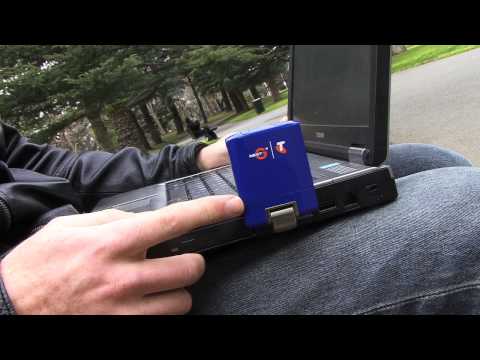
Telstra has just delivered the Federal Opposition a leg up with the release of a brand new Wireless modem than is capable of speeds up to 35Mbs. The modem which runs on the Telstra Next G Network delivers the world’s fastest national mobile broadband service, works in all capital cities and more than 100 regional centres.

Officially Telstra is claiming speeds up to 20Mps, in a demonstration conducted in Melbourne Telstra was able to achieve speeds of up to 28Mbps and up to 35Mbs during a press event in Sydney.
The new Ultimate USB is up to twice as fast as Telstra’s current fastest Next G modem.
Two thousand devices have launched today for Telstra business customers, before the widespread launch of the Ultimate later this year.
Right now wireless and fibre broadband is flavour of the day with politicans, as Labor slug it out with the Liberal Coalition who are proposing a $6.5 Billion dollar Wireless Network Vs Labors $45 Billion NBN fibre offering. 
At a delayed press briefing in Sydney today Telstra executives refused to get drawn into the political debate of fibre Vs wireless. “Its business as normal at Telstra and that means getting on with launching fast wireless broadband” said Mike Wright of Telstra’s Network Products and Services Group. 
The event which was originally scheduled for the week after the election was postponed until today.
“These new speeds mean that Australian’s can now access mobile broadband at speeds typically reserved for the office,” Telstra Business Group Managing Director, Deena Shiff said.
In area’s outside of the CBD and the 100 regional centres nominated by Telstra users of the Ultimate USB Modem will get typical download speeds of up to 8Mbps, which is still significantly faster than Telstra’s mobile broadband competitors.
“And like all Next G devices, the service always operates at 3G speeds and won’t drop back to 2G like our competitors’ mobile broadband services can do,” Ms Shiff said.

 
 “The new Telstra Ultimate USB Modem provides customers with the speeds needed to handle large files, multitask and update cloud-hosted applications effortlessly on the go.”
The Telstra Ultimate USB Modem is the world’s first commercial modem to use a new generation of mobile broadband technology called dual channel HSPA+. The modem and enabling network technology was developed in collaboration with technology companies Ericsson, Qualcomm and Sierra Wireless.
Pricing and availability
The Telstra Ultimate USB can be purchased in conjunction with a range of mobile broadband plans including for $0 upfront with a $69 plan over 24 months (minimum total cost $1,656) or outright for $299. It is available from 25 August through Telstra Business and Telstra Enterprise & Government account managers.

Harvey Norman Sales Slump As Consumers Say We Are In A Recession

Harvey Norman sales have declined 3.1% sales for the 28 days ended 23rd November 2008. Revenues are down $32 million according to CEO Gerry Harvey in a report to the Australian stock exchange.

Harvey Norman sales have declined 3.1% sales for the 28 days ended 23rd November 2008. Revenues are down $32 million according to CEO Gerry Harvey in a report to the Australian stock exchange.

Unaudited preliminary accounts for the period 1 July 2008 to 30 September 2008 indicate profit before tax and minority interests for the consolidated entity of $71.0 million compared to $103.6 million for the corresponding prior period, a reduction of 31.5%.

The decline follows a report yesterday that revealed, that a large percentage of Australians intend to wait until after Xmas to shop. According to the latest Retailers Association retail survey, 63 per cent of respondents said they were going to purchase the same amount of gifts this year, but will be more careful with the type and price of the items they purchase.

62.1% of consumers said that they believed that Australia is currently in a recession. 28.4% per cent believe the economy is stable.

The survey also reported that of the consumers who were considering buying electronics which included gaming, 14.7% planned to purchase an MP3 Player or IPod.

More than a quarter 27.1% were purchases of home electronic appliances and other electronics. However, the Nintendo Wii was also a popular choice with 13.4 per cent, followed by other computer games 12.9% being popular gifts for Christmas 2008.

Only 12.3% said that they were going to spend more money on Christmas gifts this year, whereas in 2007 it was 21.5 per cent.

“Consumers are likely to be savvier this year, and will be doing research on the internet to make sure they get the best value for money,” said Deloitte director and retail expert, Katrina Doney.

Big PR Shake Up Tipped At HP

Speculation is mounting that Bite Communications, which was previously known as Upstream, has snared Hewlett Packard, one of Australia’s largest technology PR accounts.

In an email seen by ChannelNews, HP has announced that it has extended its relationship with Bite Communications to include Europe, the Middle East and Africa and Asia-Pacific, of which Australia is the largest country in the region.

Christina Schneider, HP’s director of international external communications, said, “Selecting Bite to drive campaigns in Asia Pacific is the next step in our strategy of collaborating with the world’s best agencies to meet HP’s business needs in each of our key markets.”

She added, “Last year we chose Bite in the Unites States based on its reputation for developing creative media relations campaigns that deliver results.”

Currently HP business is handled by Burson-Marsteller which is the same agency that last month lost the LG account to Pulse, an agency under the Ogilvy & Mather PR operations.

Executives at Burson-Marsteller Sydney referred all communication on the matter to HP in Singapore.

In January, Bite Communications chose not to pitch for the Toshiba Australia account because of a possible conflict with Hewlett Packard, according to executives at Toshiba. 

And in another decision affecting Bite Communications, Cisco on Friday chose Text 100 as the PR agency for its consumer electronics division, which previously traded as Linksys. No formal announcement has yet been made.

Text 100 was last year was appointed to handle the launch of the Flip Camera from Cisco, which, despite a $2 million below-the-line marketing campaign managed by Text 100, is struggling to gain traction in retail stores, according to the latest GFK data. 


According to Bite executives in San Francisco, Bite Communications will “oversee proactive media relations campaigns that support HP’s corporate innovation and sustainability initiatives. The addition of Asia Pacific builds significantly on the companies’ existing relationship, which began in August 2009 when HP awarded Bite the same corporate work in the United States”, the company said in a statement issued to ChannelNews.

Clive Armitage, CEO of Bite Communications, said, “At Bite, we have a desire to work with brands that want to create and drive meaningful and innovative communications, HP certainly fits that bill.”

HP is the world’s largest technology company with a portfolio that spans printing, personal computing, software, services and IT infrastructure.

$37M DJ’s Accuser Exposed For Prior Sexual Harassment Claims

A former Optus employee who is suing retailer David Jones and its former CEO for sexual harassment has been exposed as having made prior harassment claims while working for the NSW Police.

Publicist Kristy Fraser-Kirk is claiming $37 million in damages against David Jones and former CEO Mark McInnes who she claims made sexual advances to her while employed at the retailer.
Now it’s been revealed that Fraser Kirk made a similar complaint against her boss SSgt Michael Magill while working as a civilian for the NSW Police.
Questions are also being raised about the judgement of her PR adviser Anthony McClellan a former A Current Affair and Sixty minutes Producer. McClellan has been accused by the Sunday Telegraph of dishing out “dreadful advice” to Fraser-Kirk who a called a press conference on the day prior to David Jones Spring fashion showing.
McClellan who has a history of poor judgement once told A Current Affair researcher to “go away” when a story was put to him. The researcher then took the story to senior management who backed the researcher. The story won a Logie. 
According to the Sunday Telegraph Fraser-Kirk accused the police officer of sending her inappropriate text messages. The formal complaint was investigated by two police inspectors.
Sgt McGill is still employed by the NSW Police Force.
In her latest attempt to extract cash from David Jones and McInnes, Fraser-Kirk has had her advisers set up a hot line in an effort to get other David Jones staff to complain.

 
However several former police colleges of Fraser Kirk have come forward claiming that she tried to solicit them to complain when she laid a complaint against her former police boss.
The women are said to be furious at her actions claiming that she went out of her way to try and smear SSgt Michael Magill.
“She tried to make out he was a sleaze. She wanted us to complain and make a stronger case against him” one of the women said.
None of the women supported her claims.
Investigations are also being made at Optus where it is believed she also made complaints.
Both Anthony McClellan and Kristy Fraser-Kirk are refusing to comment on the latest allegations.

Telstra Cuts $11B Deal With NBN Shares Set To Climb

The Federal Government has thrown in the towel and signed an $11 billion dollar deal with Telstra that gives them access to the telecommunication carriers copper network, exchanges and other infrastructure needed to roll out the National Broadband Network’s fibre network across Australia.

The Federal Government has thrown in the towel and signed an $11 billion dollar deal with Telstra that gives them access to the telecommunication carriers copper network, exchanges and other infrastructure needed to roll out the National Broadband Network’s fibre network across Australia.
The deal announced by Prime Minister Kevin Rudd and Communications Minister Stephen Conroy, will see Telstra share climb tomorrow, as analysts realise that Telstra has achieved a deal that will benefit the carrier as they roll out new revenue services such as Telstra BigPond movies, TV content and new services for the connected home. 
Under the deal, NBN Company will have access to Telstra’s network ducts, wires and infrastructure which will allow the NBN to roll out the fibre network quicker than without Telstra. 
As part of the deal, Telstra will migrate their customers onto the fibre network. Telstra will receive $9 billion over 6 years to compensate for NBN Co using its infrastructure and the loss of future income from fixed-line customers. 
According to the Sydney Morning Herald, a further $2 billion of government money will be used to set up a new company called USO Co, to look after Telstra’s Universal Service Obligations, retrain Telstra staff, and make NBN Co a wholesale supplier of fibre for new housing developments from January 1, next year.
As part of the deal Telstra gets a number of regulatory concessions worth approximately $2 billion. They also get to keep their 50% in Foxtel and they will be allowed to bid for  4G spectrum as it becomes available. 
The deal still has to be approved by the Australian Competition and Consumer Commissaion and if approved will deliver Telstra a post-tax net value of approximately $11 billion.
Prime Minister Kevin Rudd said that negotiations with Telstra had been ”very difficult, tough, hard”, with some analysts claiming that Rudd did not want to go the next Federal Election fighting with Telstra over the NBN.
More to follow.